
Materials Engineering for Electrolyzer Degradation Mitigation
Author: Arun, Chief Engineer at Avoltium
1. Introduction to Electrochemical & Thermal Stressors in Water Electrolysis
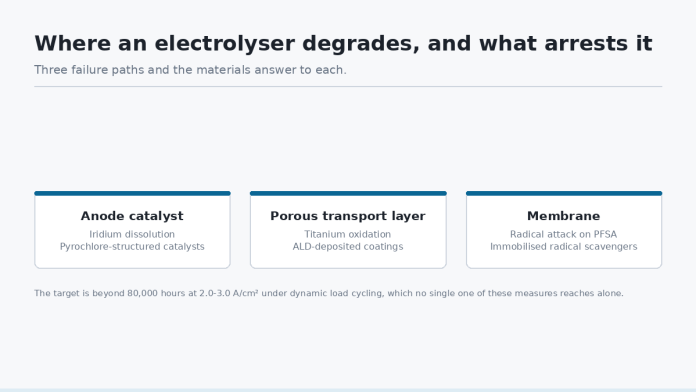
To achieve cost-competitive green hydrogen production, modern industrial low-temperature water electrolysis platforms—specifically Proton Exchange Membrane (PEM) and Anion Exchange Membrane (AEM) architectures—must operate at elevated current densities exceeding 2.0 A/cm2 to 3.0 A/cm2 while maintaining operational lifespans beyond 80,000 hours. Achieving these metrics presents a profound materials science challenge. The total cell potential (Vcell) required to drive water splitting is governed by thermodynamic, kinetic, and ohmic losses:
Vcell = Erev + ηanode + ηcathode + i·Rohmic + i·Rmass_transport
Where Erev is the reversible thermodynamic cell voltage (1.23 V at standard temperature and pressure, shifting according to the Nernst equation at elevated operational temperatures), ηanode and ηcathode represent the overpotentials for the Oxygen Evolution Reaction (OER) and Hydrogen Evolution Reaction (HER) respectively, and i·R terms quantify internal ohmic and mass transport resistance. Under real-world operating conditions—characterized by high cell potentials (Vcell > 1.8 V to 2.2 V), aggressive pH environments (pH < 1 for PEM, pH > 13 for AEM), elevated operating temperatures (65 °C to 85 °C), and intermittent power profiles driven by renewable input—materials inside the electrolyzer undergo severe degradation.
Addressing these degradation pathways requires an interfacial engineering approach, mitigating catalyst dissolution, passivation of titanium transport structures, polymer membrane chemical unzipping, and mechanical fatigue within a single unified stack architecture.
2. Anode Dissolution Kinetics & Advanced Electrocatalyst Stabilization
The anode catalyst operates in one of the most aggressive electrochemical environments in industrial processing. During the OER at the PEM anode, high operating potentials (E > 1.4 V to 2.0 V vs. RHE) combined with an acidic perfluorosulfonic acid (PFSA) ionomer interface cause significant dissolution of precious metal catalysts. While Iridium oxide (IrOx) remains the state-of-the-art catalyst for acidic OER due to its superior catalytic activity compared to Platinum and lower dissolution rate compared to Ruthenium, it is not thermodynamically stable at high anodic potentials.
Catalyst Dissolution Mechanisms
The dissolution of IrO2 occurs primarily via the formation of highly oxidized, soluble species such as IrO42- or transient IrV+ / IrVI+ intermediates formed during the oxygen evolution catalytic cycle. The transition from active solid-state Ir-O coordination structures to hydrated aqueous ions results in continuous mass loss of the catalytic layer, loss of active electrochemical surface area (ECSA), and a progressive rise in anode overpotential (ηanode).
“Transitioning from planar to three-dimensional, support-passivated catalyst architectures has allowed us to reduce precious metal loading by 65% while simultaneously decreasing the dissolution rate of iridium by an order of magnitude under accelerated stress testing.”
Mitigation Strategies: Structured Pyrochlores and Core-Shell Architectures
To stabilize the catalytic phase against dissolution without sacrificing mass activity (A/mgIr), Avoltium has pioneered several advanced material modifications:
- Pyrochlore Oxide Catalysts: Synthesizing multimetallic pyrochlores such as Y2Ir2O7-δ and Bi2Ir2O7 stabilizes the Ir-O octahedral network through structural pinning within the cubic lattice. This shifts the dissolution threshold to significantly higher potentials.
- Core-Shell Nanostructures: Encapsulating stable conductive ceramic supports—such as Antimony-doped Tin Oxide (ATO) or Titanium Oxynitride (TiON)—with thin, highly crystalline IrO2 shells (1 to 3 nm) maximizes specific surface area while preventing core oxidation.
- Crystalline-Amorphous Phase Tuning: Hybrid catalysts featuring an amorphous active surface layer over a crystalline IrO2 core balance low initial charge-transfer resistance with long-term structural integrity.
3. Porous Transport Layer (PTL) Passivation & Interfacial Resistance
The Porous Transport Layer (PTL) at the anode—typically constructed from sintered titanium fibers or powder—serves multiple critical roles: uniform liquid feed distribution, gas removal, mechanical support for the membrane electrode assembly (MEA), and electrical charge conduction between the bipolar plate and the catalyst layer.
Titanium Oxide Passivation Dynamics
In the highly oxidizing acidic anode environment, raw titanium rapidly forms an insulating native oxide film (TiO2). While this film passivates the bulk titanium against catastrophic structural corrosion, TiO2 possesses an extremely wide bandgap (~3.0 eV to 3.2 eV), making it electronically insulating. As the TiO2 layer thickens over time, the interfacial contact resistance (ICR) between the PTL and the anode catalyst layer increases exponentially, driving up i·Rohmic losses and compromising system efficiency.
“The integration of localized redox scavengers alongside ultra-thin ePTFE reinforcement structures provides a dual-defense mechanism, suppressing chemical attack while maintaining physical membrane integrity across tens of thousands of differential pressure dynamic cycles.”
Surface Engineering Coatings for PTLs
To arrest TiO2 growth while preserving conductivity, surface modification techniques are mandatory:
- Physical Vapor Deposition (PVD) Coating: Depositing ultra-thin layers (20 nm to 50 nm) of Platinum or Iridium via Magnetron Sputtering provides a corrosion-resistant, highly conductive contact surface that prevents interstitial oxygen diffusion into the titanium substrate.
- Atomic Layer Deposition (ALD): Applying atomic-scale conductive nitrides (TiN, TiCN) or Nb-doped TiO2 coatings achieves complete conformal coverage across complex 3D porous titanium microstructures, eliminating pinholes that serve as initiation sites for localized passivating oxidation.
The Critical Role of Upstream Water Treatment
The operational lifespan of both the PTL protective coatings and the active catalysts is intrinsically linked to feed purity. Modern high-power electrolyzer systems demand stringent upstream Water Treatment to prevent catastrophic electrochemical fouling. Trace metallic impurities (e.g., Fe2+/Fe3+, Cu2+, Cr3+) or silicates present in low-quality feed water migrate under the electric field to the cathode, precipitating as non-conductive metallic dendrites or hydroxides. Furthermore, halide ions such as Chloride (Cl–) aggressively breach passive protective layers on titanium components, initiating localized pitting corrosion. Upstream Water Treatment systems must continuously deliver ultra-pure water with resistivity values exceeding 18.2 MΩ·cm and Total Organic Carbon (TOC) levels below 5 ppb to guarantee stack longevity.
4. Polymer Membrane Degradation: Chemical Peroxide Attack & Mechanical Creep
The solid polymer electrolyte—typically perfluorosulfonic acid (PFSA) membranes such as Nafion or short-side-chain (SSC) Aquivion—is susceptible to both chemical and mechanical degradation pathways that can lead to gas crossover, internal shorting, and stack failure.
Chemical Degradation via Reactive Oxygen Species (ROS)
Dissolved H2 and O2 gases diffuse across the membrane (gas crossover), encountering precious metal nanoparticles deposited or dissolved at the catalyst interfaces. This interaction catalyzes the formation of hydrogen peroxide (H2O2), which decomposes into highly reactive hydroxyl (·OH) and hydroperoxyl (·OOH) radicals via Fenton-type reactions accelerated by trace iron (Fe2+) impurities:
Fe2+ + H2O2 + H+ → Fe3+ + ·OH + H2O
These electrophilic radicals attack weak carboxylic acid end-groups (–COOH) present in the polymer matrix, initiating a chain reaction known as polymer unzipping:
Rf–CF2COOH + ·OH → Rf–CF2· + CO2 + H2O
This attack causes continuous membrane thinning, loss of ion-exchange capacity (IEC), and increased fluoride emission rates (FER) in the effluent stream.
Mitigation of Radical Attack and Mechanical Stress
To suppress chemical degradation, transition metal ion radical scavengers—primarily Cerium (Ce3+/Ce4+) or Manganese (Mn2+/Mn3+)—are doped directly into the PFSA matrix. Ce3+ ions rapidly quench hydroxyl radicals through cyclical redox reactions:
Ce3+ + ·OH + H+ → Ce4+ + H2O
To resist mechanical stress driven by high differential pressures (>30 bar) and localized hydration cycling, membranes are mechanically reinforced using an expanded polytetrafluoroethylene (ePTFE) porous matrix impregnated with SSC PFSA ionomer. The ePTFE scaffold limits planar swelling, increases tensile strength, and prevents mechanical creep failure over tens of thousands of dynamic operational hours.
5. Materials Validation under Accelerated Stress Testing (AST)
To validate materials performance, Avoltium utilizes standardized Accelerated Stress Testing (AST) protocols designed to isolate specific degradation modes under compressed timeframes:
| AST Protocol Focus | Stress Conditions | Primary Failure Mode Evaluated | Target Metric |
|---|---|---|---|
| Anode Catalyst Stability | Square-wave potential cycling (1.4 V to 2.0 V vs. RHE, 10 Hz, 80 °C) | IrOx electrocatalyst dissolution and surface area loss | < 10 µV/hr degradation over 10,000 cycles |
| PTL Interface Integrity | Constant anodic bias (2.2 V vs. RHE, 80 °C, dry O2 purge) | Titanium passivation layer growth and ICR increase | ICR < 5 mΩ·cm2 at 1.5 MPa compression |
| Membrane Chemical Durability | Open Circuit Voltage (OCV) hold at 90 °C, 30% RH with H2/Air feed | Peroxide radical generation and ionomer unzipping | FER < 1×10⁻⁷ g/cm2·hr |
By coupling advanced materials engineering—pyrochlore catalyst structures, conformal PVD/ALD protective coatings, Ce-impregnated ePTFE reinforced membranes—with meticulous upstream Water Treatment and stack power management, modern commercial Electrolyzer designs can achieve robust long-term durability. At Avoltium, these integrated materials advancements allow us to maintain high system efficiency (< 43 kWh/Nm3 H2) across the lifetime of our platforms, paving the way for scalable, economical green hydrogen infrastructure.