

1. The High-Pressure Alkaline Stack Environment: Tri-Phase Stressors
In high-pressure pressurized alkaline water electrolysis, cell stack sealing presents one of the most demanding multi-physics challenges in modern chemical engineering. Modern industrial Electrolyzer designs operate at pressures ranging from 30 bar to 50 bar and elevated temperatures between 80°C and 90°C. Within each cell unit, the sealing interface must concurrently isolate three distinct phases: highly concentrated liquid electrolyte (typically 25 wt% to 35 wt% KOH), wet pressurized hydrogen gas (H2), and wet pressurized oxygen gas (O2).
The transition from atmospheric or low-pressure legacy stacks to high-pressure zero-gap configurations significantly intensifies mechanical and chemical demands on elastomeric gaskets. The operational environment imposes three continuous, interacting stressors:
- Chemical Stressors: Continuous contact with hot, concentrated hydro-alcoholic KOH solutions and highly oxidizing dissolved O2 species at the anode, alongside atomic and molecular H2 exposure at the cathode.
- Mechanical Stressors: High internal system hydraulic pressure (Psys = 3.0 to 5.0 MPa), sudden differential pressure spikes (ΔP up to 0.5 MPa across cell separators during dynamic transients), and cyclic compressive forces generated by thermal expansion and stack clamping.
- Thermal Stressors: Thermal cycling from ambient startup (20°C) to full load operating temperature (90°C), driving thermal expansion mismatch between metallic or polymeric bipolar plates and elastomeric gasket bodies.
2. Polymer Chemistry and Material Selection Matrix
Selecting an appropriate elastomer compound requires evaluating chemical inertness, compression set resistance, and gas permeability. Standard industrial elastomers such as Nitrile (NBR), Chloroprene (CR), and sulfur-cured Ethylene Propylene Diene Monomer (EPDM) degrade rapidly in high-pressure hot KOH environments through backbone cleavage and crosslink hydrolysis.
“Sulfur-cured elastomers fail catastrophically in hot alkaline media because nucleophilic attack by hydroxyl ions (OH–) cleaves mono-, di-, and poly-sulfidic crosslinks. Only peroxide-cured networks with high carbon-carbon backbone integrity can sustain long-term structural elasticity.”
Peroxide-Cured EPDM vs. Specialized Fluoroelastomers
Peroxide-cured EPDM with a high ethylene content (60% to 70% by weight) and a low diene content (norbornene derivatives like ENB < 2%) remains the baseline material choice for high-pressure alkaline stacks. Peroxide crosslinking creates direct C-C bonds that are immune to alkaline hydrolysis. However, at temperatures exceeding 85°C in oxygen-saturated KOH loops, EPDM is subject to oxidative embrittlement over long operational lifetimes (>80,000 hours).
Fluoroelastomers (FKM) present complex tradeoffs. While standard bisphenol-cured FKMs undergo rapid alkaline dehydrofluorination—leading to polymer backbone double bond formation, severe embrittlement, and ultimate cracking—base-resistant FKM grades (FEPM / Tetrafluoroethylene-Propylene copolymers) exhibit superior resistance to 30 wt% KOH. FEPM maintains structural integrity up to 100°C; however, its higher glass transition temperature (Tg ≈ 0°C) limits low-temperature sealing effectiveness during cold climate startups compared to EPDM (Tg ≈ -50°C).
Filler Metallurgy and Water Treatment Purity Constraints
The compounding formula of the seal is as critical as the base polymer. Conventional elastomer formulations utilize precipitation-grade amorphous silica (SiO2) as a reinforcing filler. In hot concentrated alkaline solutions, silica dissolves into potassium silicate:
SiO2 + 2 KOH → K2SiO3 + H2O
This reaction erodes the mechanical integrity of the gasket body, causing matrix voiding, accelerated compression set, and severe structural leakage. Furthermore, the leached silicate ions migrate into the circulating electrolyte loop, contaminating the porous diaphragms (such as ZrO2-based separators) and poisoning the cathode/anode electrocatalysts.
At Avoltium, sealing specifications mandate pure furnace carbon black reinforcement (FEF or HAF types) paired with inert metal oxides (e.g., TiO2 or BaSO4). The deionized feed water delivered to the Electrolyzer balance-of-plant must pass through dedicated auxiliary Water Treatment units—including reverse osmosis (RO) and electrodeionization (EDI) polishing—to maintain feed water conductivity below 0.1 μS/cm. If elastomeric compounds contain extractable ionic species, plasticizers, or unreacted crosslinking agents, they degrade the efficiency of both the internal stack electrochemistry and the external Water Treatment regeneration loops.
3. Mechanical Interface Design and Stress Relaxation Engineering
To guarantee zero-leakage performance over decades of operation, the local contact pressure between the elastomeric gasket and the bipolar plate frame (σcontact) must satisfy the classic sealing criterion:
σcontact ≥ α · Pinternal
Where Pinternal is the fluid pressure (up to 5.0 MPa) and α is the safety sealing factor, typically calibrated between 1.5 and 2.5 for gaseous hydrogen containment. Achieving this contact pressure requires precise non-linear hyper-elastic structural modeling (using Mooney-Rivlin or Ogden constitutive material models) during gasket geometry design.
Sealing Profile Architecture
Flat sheet gaskets are unsuitable for high-pressure stacks due to high required bolt loads, poor conformability, and high stress relaxation rates. Modern high-pressure stacks utilize either precision-molded tongue-and-groove profiles or elastomer-overmolded structural frame beads.
Comparative Profiles for 30+ Bar Stack Sealing
- Flat Elastomeric Sheeting: Poor strain energy recovery; initial bolt force relaxes by >40% within 1,000 hours. Prone to lateral blow-out under system pressure spikes.
- O-Ring in Rectangular Groove: Effective localized sealing, but high risk of physical twisting during long-stroke manual stack assembly. Subject to gap extrusion at ΔP > 10 bar unless back-up rings are integrated.
- Engineered Lobed / Molded-In-Place Seals: Optimizes contact stress concentration at primary sealing lobes while providing low structural force requirements during stack compression. Incorporates anti-extrusion shoulders to resist ΔP displacement.
Viscoelastic Stress Relaxation Kinetics
Elastomers under constant compressive strain exhibit stress relaxation over time, described mathematically by the stretched exponential Kohlrausch-Williams-Watts (KWW) decay model:
σ(t) = σ0 · exp[ -(t / τ)β ]
Where σ0 is the initial sealing stress, τ is the characteristic relaxation time constant, and β is the fractional relaxation exponent (0 < β ≤ 1). Thermal exposure and chemical plasticization from KOH accelerate the relaxation rate (reducing τ). If σ(t) drops below α · Pinternal, localized interfacial bypass leakage occurs.
“Compression set test values under static air conditions (ISO 815) are fundamentally misleading for electrolyzer engineering. Sealing materials must be qualified using dynamic mechanical analysis (DMA) under direct immersion in 30 wt% KOH at 90°C under 5 MPa hydraulic bias.”
4. Managing Differential Pressure Transients and Gas Permeation
Modern commercial Electrolyzer installations are coupled with intermittent renewable energy sources (solar PV and wind power). Rapid ramping of power input (from 5% to 120% nominal load in sub-second intervals) generates transient differential pressure (ΔP) fluctuations between the oxygen and hydrogen channels.
Extrusion Resistance and Mechanical Back-Up Integration
When ΔP across adjacent cell compartments spikes, the elastomeric gasket material is forced into the microscopic clearance gaps between the bipolar plate frames and the separator frame. If the shear stress at the gap edge exceeds the tear strength of the elastomer, micro-nibbling and extrusion failure occur.
To mitigate extrusion at 30–50 bar operating pressures, seal geometries incorporate high-modulus thermoplastic back-up rings or integrated support shoulders composed of polyphenylene sulfide (PPS) or polyether ether ketone (PEEK). These rigid engineering polymers possess high flexural moduli (>3.5 GPa) and resist alkaline degradation up to 120°C, providing mechanical support to the elastomeric sealing lip.
Hydrogen Permeation and Explosive Decompression
Because molecular hydrogen possesses an extremely small kinetic diameter (0.289 nm), H2 gas readily dissolves into and diffuses through elastomeric polymers under 50 bar pressure according to Fick’s Law of Diffusion:
J = -D · (∂c / ∂x)
Where J is the gas permeation flux, D is the diffusion coefficient of H2 in the polymer matrix, and ∂c/∂x is the concentration gradient across the seal cross-section. Selecting high-density crosslinked formulations lowers the diffusion coefficient D. Furthermore, during rapid stack depressurization events (e.g., emergency shutdown), gas dissolved inside the polymer matrix expands rapidly. If the pressure drop rate (dP/dt) exceeds the gas diffusion rate out of the matrix, internal micro-cavitation occurs, causing Explosive Decompression (ECD) failure. Formulations must be certified for ECD resistance per NACE TM0192 standards under compressed hydrogen media.
5. Assembly Verification, Belleville Compensation, and Quality Control
The total compression force applied to a high-pressure stack can exceed several Meganewtons (MN). For a 100-cell stack with a 1.5 m2 active area, thermal expansion differential along the longitudinal axis of the stack can account for several millimeters of axial movement between cold ambient state and steady-state 90°C operation.
Thermal Expansion Compensation
Because the coefficient of thermal expansion (CTE) of the polymer gasket (CTE ≈ 100–200 × 10-6 K-1) is an order of magnitude higher than that of metallic bipolar plates (CTE ≈ 10–17 × 10-6 K-1), thermal cycling induces cyclic strain amplitude within the seal channels. To prevent over-compression at elevated temperatures and loss of contact stress upon cooling, heavy-duty Belleville spring washer stacks are integrated into the primary tie-rod assemblies. These disk springs maintain a nearly constant axial clamping force (Fclamp ± 5%) across the full operating temperature envelope.
Quality Control and Stack Integrity Testing
Prior to wet operational commissioning, high-pressure stacks must undergo rigorous non-destructive quality control verification:
- Helium Mass Spectrometry Leak Testing: Individual cells and fully assembled stack perimeters are pressurized with a 10% He / 90% N2 tracer gas mix to 1.1 times maximum allowable working pressure (MAWP). Total integrated leak rates must remain below 1 × 10⁻⁶ mbar·L/s.
- Differential Pressure Decay Analysis: Anode and cathode loops are independently pressurized to verify internal diaphragm-to-gasket interface integrity, ensuring zero cross-port leakage under a 0.5 MPa static ΔP offset for a minimum 60-minute hold period.
- Electrochemical Impedance Diagnostics: High-frequency impedance measurement across the compressed stack validates uniform mechanical contact resistance (Rcontact) across all bipolar plates, confirming that seal compression has not distorted the zero-gap internal cell architecture or crushed the porous transport layers.
By combining rigorous polymer chemistry formulation, non-linear finite element structural optimization, and robust dynamic mechanical clamping, modern high-pressure alkaline sealing technology provides the foundational platform for safe, continuous, ultra-long-life industrial hydrogen generation.
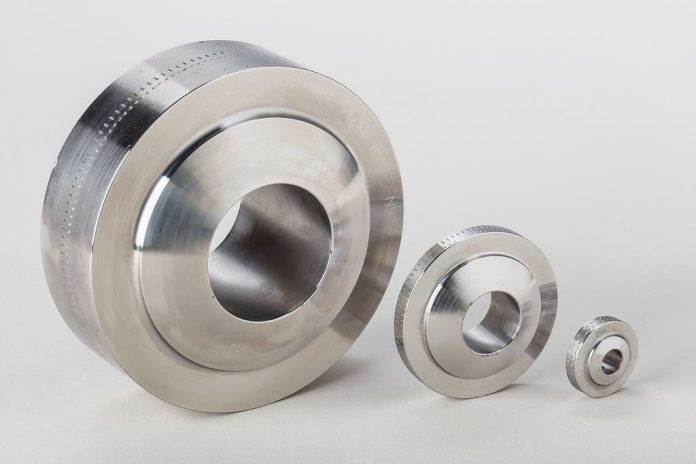
Image: Lens ring gaskets 01 by CEphoto, Uwe Aranas, licensed under CC BY-SA 3.0.