
1. Introduction: The Critical Role of High-Purity Water in Electrolysis
In modern power-to-gas infrastructure, the quality of feed stream preparation directly governs the degradation rates, thermal performance, and overall stack lifespan of an industrial Electrolyzer. Whether deploying Proton Exchange Membrane (PEM), Anion Exchange Membrane (AEM), or advanced Alkaline Water Electrolysis (AWE) stacks, incoming feed chemistry must meet stringent ASTM D1193 Type I guidelines or better, often requiring continuous resistivity exceeding 15 to 18.2 MΩ·cm at 25 °C, with Total Organic Carbon (TOC) levels under 10 ppb.
Contaminants present in raw water supplies—such as trace cations (Fe2+, Fe3+, Cu2+, Ni2+, Ca2+, Mg2+), anions (Cl–, SO42-), weak species (reactive and unreactive SiO2, H3BO3), and dissolved organics—pose existential threats to the cell stack architecture. Ions migrate under the intense internal electric field of the stack, accumulating at catalyst sites, blocking active transport pores within the porous transport layer (PTL), and fouling ionomeric membrane sites. Effective, ultra-reliable Water Treatment design is not merely an auxiliary utility balance-of-plant (BoP) consideration; it is a core engineering requirement for hydrogen production efficiency.
“Maintaining sub-ppb levels of multivalent cations and unreactive silica is not merely a water treatment preference; it is an absolute thermodynamic and mechanical prerequisite for mitigating irreversible voltage decay in modern electrolyzer stacks.”
2. Mixed-Bed Polishing (MBDI): Mechanisms, Operation, and Vulnerabilities
Mixed-Bed Deionization (MBDI) has historically served as the benchmark technology for achieving ultrapure water polish. The system utilizes an intimately mixed bed of Strong Acid Cation (SAC) exchange resins in the hydrogen (H+) form and Strong Base Anion (SBA) exchange resins in the hydroxyl (OH–) form packed within a single pressure vessel.
2.1 Thermodynamics of Ion Exchange and Breakthrough Kinetics
As pre-treated water (typically Reverse Osmosis permeate) enters the bed, target ions undergo rapid ion exchange across the solid-liquid boundary layer:
R-H + M+ ⇌ R-M + H+
R-OH + X– ⇌ R-X + OH–
The released H+ and OH– ions immediately neutralize to form H2O, shifting the reaction equilibrium strongly to the right and driving the solution resistivity up to the theoretical limit of 18.18 MΩ·cm at 25 °C. However, the system’s efficacy is fundamentally limited by mass transfer zone dynamics and exhaustion behavior. Weakly held species—specifically silicic acid (H4SiO4) and boric acid (H3BO3)—exhibit low selectivity coefficients on SBA resins. As the bed approaches exhaustion, these weakly bound species undergo competitive displacement by strongly bound anions such as SO42- and Cl–, leading to silica breakthrough before any measurable drop in bulk product water resistivity occurs.
2.2 Operational Considerations and Regeneration Realities
Mixed-bed exchangers operate strictly as batch processes. Once the functional sites are exhausted, the media must undergo either on-site chemical regeneration using concentrated hydrochloric acid (HCl) and sodium hydroxide (NaOH) or off-site replacement (Service Deionization/PEDI). On-site regeneration introduces significant operational complexity:
- Hydraulic Separation Risks: Incomplete fluidization and backwashing separation of SAC and SBA resins leads to cross-contamination during chemical injection, causing prolonged post-regeneration rinse times and early ionic leakage.
- Hazardous Chemical Management: Handling, storing, and neutralizing bulk acid and caustic reagents introduces strict site safety constraints and environmental permitting overhead.
- Batch Resistivity Fluctuation: Water quality follows a standard S-curve decay, producing variable resistivity and trace ionic spikes during transitional phases, which directly exposes the Electrolyzer stack to trace contaminants.
3. Continuous Electrodeionization (EDI): Electromembrane Physics and Self-Regeneration
Electrodeionization (EDI) integrates conventional ion-exchange resin media, ion-selective membranes, and a direct-current (DC) electric field to establish a continuous, chemical-free ultrapure water purification process. Rather than acting as a finite chemical sink, the resin inside an EDI module serves as an electrochemical bridge, accelerating ionic transport toward permselective membranes.
3.1 Electrodialytic Transport and In-Situ Water Splitting
An EDI cell pair consists of a dilute (product) channel packed with mixed ion-exchange resin, bounded by a Cation Exchange Membrane (CEM) on one side and an Anion Exchange Membrane (AEM) on the other, flanked by adjacent concentrate channels. Under the influence of an externally applied DC potential, cations migrate through the resin bed and CEM toward the cathode, while anions migrate through the SBA resin and AEM toward the anode.
As ionic species are stripped from the bulk fluid in the dilute channel, localized concentration polarization occurs at the boundaries between the ion-exchange resin beads and the membrane surfaces. When local ion concentration approaches zero, the intense localized electrical field gradient (exceeding 105 V/cm) splits water molecules into hydrogen (H+) and hydroxyl (OH–) ions:
H2O → H+ + OH–
This localized in-situ electro-regeneration continuously restores the resin beads to their fully regenerated H+ and OH– active states without halting operations or introducing chemical reagents. Consequently, the module maintains steady-state operation, eliminating the cyclical breakthrough patterns inherent to traditional resin beds.
3.2 Feedwater Conditioning Requirements for EDI
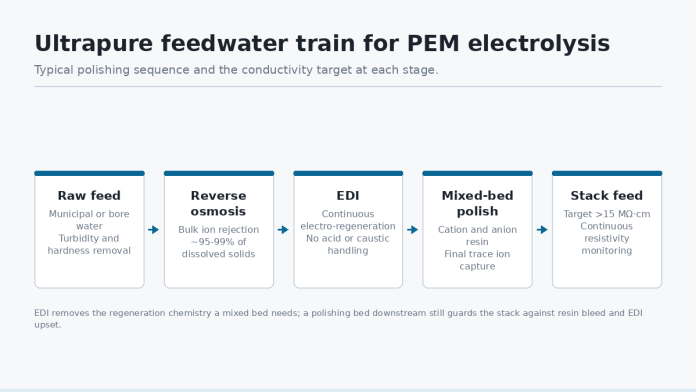
Because EDI modules rely on narrow channels and sensitive electro-membranes, pretreatment upstream of the EDI unit is mandatory. The feed water must undergo primary demineralization, typically via two-pass RO or single-pass RO coupled with a Liqui-Cel membrane contactor for carbon dioxide (CO2) degasification. Dissolved CO2 converts to bicarbonate (HCO3–) at prevailing pH levels, acting as a competing anion that reduces EDI silica removal efficiency if not stripped upstream. Total hardness must be kept below 0.5 ppm (as CaCO3) to prevent localized scaling on the concentrate side of the Cation Exchange Membrane.
“While Mixed-Bed polishers offer lower initial capital expenditure, EDI converts an unpredictable, batch-based chemical operation into a reliable, steady-state electrochemical unit process perfectly aligned with power-to-gas plant automation.”
4. Technical Performance Matrix: EDI vs. Mixed-Bed Polishing
The selection of polishing architecture dictates plant footprints, auxiliary power budgets, maintenance intervals, and process reliability. The comparative table below outlines key engineering metrics across both technologies:
| Performance Parameter | Mixed-Bed Ion Exchange (MBDI) | Continuous Electrodeionization (EDI) |
|---|---|---|
| Product Resistivity | 15 – 18.0 MΩ·cm (Cyclic variability) | 16 – 18.2 MΩ·cm (Constant steady-state) |
| Reactive Silica (SiO2) Rejection | 95 – 98% (Risk of early breakthrough) | 99.0 – 99.9% (Continuous sub-ppb) |
| Boron (H3BO3) Removal | Variable depending on resin exhaustion | > 98% continuous rejection |
| Chemical Requirement | Hazardous bulk reagents (HCl, NaOH) | None (Chemical-free continuous operation) |
| Power Consumption | Negligible (Pumping energy only) | 0.10 – 0.35 kWh/m3 (DC current) |
| Process Water Recovery | 93 – 95% (Net of regeneration/rinse) | 90 – 95% (Reject continuous feed return) |
| OPEX Profile | High (Regenerants, resin disposal, labor) | Low (Electricity, periodic cleaning/CIP) |
| CAPEX Profile | Lower initial capital investment | Higher initial module and power supply cost |
5. Degradation Mechanics within the Electrolyzer Stack
To quantify why steady-state water purity is crucial, consider the electrochemical cell voltage breakdown of an operating PEM or Alkaline Electrolyzer:
Vcell = Erev + ηanode + ηcathode + i · Rohmic
Where Erev is the reversible cell potential, η represents the overpotentials at the respective electrodes, i is the operational current density (A/cm2), and Rohmic encapsulates the total internal area-specific resistance, including ionic transport resistance through the membrane and electrical contact resistance.
Trace impurity breakthrough alters this equilibrium rapidly through three distinct mechanisms:
- Cationic Exchange Interference: Multivalent cations (e.g., Ca2+, Fe3+) exhibit a higher affinity for the sulfonic acid functional groups (-SO3–) in perfluorosulfonic acid (PFSA) membranes than the primary charge carrier, H+. These heavy cations replace H+ within the membrane matrix, significantly depressing local ionic conductivity and driving up Rohmic over time.
- Electrode Poisoning: Heavy metals that migrate to the cathode undergo electrochemical reduction and electroplate onto precious metal catalyst sites (Platinum/Iridium oxide). This reduces the active surface area, raising the kinetic overpotentials ηanode and ηcathode, requiring higher operating voltages to sustain the target hydrogen output rate.
- Silica Polymerization: Reactive silica passing into the high-temperature zone of the stack dehydrates and polymerizes into insoluble silicon dioxide (SiO2) precipitates inside the micro-porous transport layers. This causes mass transport resistance to spike, triggering localized hot spots and accelerated degradation of the solid polymer electrolyte.
6. Economic and Lifecycle Analysis: 100 MW Green Hydrogen Case Study
Evaluating Water Treatment configurations for a 100 MW PEM electrolysis facility delivering approximately 2,000 Nm3/h of green H2 requires roughly 20 m3/h of continuous ultrapure feedwater. Below is a high-level OPEX comparison between a dual-pass RO + MBDI and a dual-pass RO + Degasser + EDI system operating over a 10-year lifespan:
6.1 Operational Cost Drivers
- MBDI System: Assuming off-site service resin exchange at 190,000 annually, excluding spent resin disposal fees and secondary waste management costs. On-site regeneration alternatives add chemical infrastructure, neutralizing pits, and maintenance labor costs.
- EDI System: Consuming 0.25 kWh/m3 at an industrial electricity tariff of 2,628 annually. Accounting for module replacement reserves (assuming a 7-to-10-year stack life) and annual Clean-in-Place (CIP) chemical flushes, total annual OPEX is controlled below $28,000.
Despite the 30% to 45% higher upfront CAPEX for the EDI system and its associated power distribution units, the amortization payback period relative to MBDI is achieved within 2.2 years of continuous operation. Furthermore, mitigating trace silica and cation spikes preserves the multi-million-dollar electrolyzer stack, significantly lowering total cost of ownership (TCO).
7. Engineering Conclusion and Avoltium Design Standards
For modern, utility-scale hydrogen production where system uptime, high Faradaic efficiency, and low stack degradation rates are key performance indicators, traditional Mixed-Bed Polishing presents unacceptable operational liabilities. The continuous nature, steady-state quality output, low operating cost, and automated operational profile make Continuous Electrodeionization the superior choice for feed stream preparation.
At Avoltium, our baseline balance-of-plant design standard mandates a multi-barrier purification train: Primary RO → Hydrophobic Membrane Degasification → Secondary RO → Continuous EDI → 0.05 µm Ultra-low Charge Retention Post-Filter. This configuration guarantees consistent 18.2 MΩ·cm product water, protecting electrolyzer cell stacks against premature performance loss and delivering reliable, long-term green hydrogen production.