

Deconstructing the Battery vs. Hydrogen Dichotomy
In clean energy discourse, public debate frequently frames battery energy storage systems (BESS) and green hydrogen as rivals competing for grid dominance. When evaluated through the lens of process engineering, thermodynamic efficiency, and capital expenditure (CAPEX) scaling, this binary dynamic collapses. BESS and hydrogen are not competing technologies on a single axis; they are complementary systems engineered for distinct load profiles, duration scales, and thermodynamic boundaries.
To optimize power systems and industrial chemical hubs, engineers must evaluate energy storage through two key metrics: round-trip efficiency (RTE) and volumetric/gravimetric energy density over time. Batteries excel at high-efficiency, fast-response power shifting over hours. Hydrogen excels where long discharge durations, massive energy capacity, or molecular feedstocks are required.
Thermodynamics and Economic Scaling Boundaries
The engineering trade-off between battery and hydrogen architectures boils down to how capital costs scale with capacity (kWh) versus power output (kW).
For lithium-iron-phosphate (LFP) or nickel-manganese-cobalt (NMC) battery installations, scaling storage duration from 4 hours to 48 hours requires a near-linear multiplication of cell modules, battery management racks, and enclosure footprints. The marginal cost per additional kilowatt-hour remains relatively flat, typically around 180/kWh at the DC block level. Consequently, BESS becomes capital-prohibitive for multi-day or seasonal energy storage.
In contrast, green hydrogen production decouples power capacity from energy capacity. The power unit—the electrolyzer stack—carries a substantial upfront capital cost (1,100/kW for Proton Exchange Membrane [PEM] systems, or 700/kW for pressurized Alkaline systems). However, scaling energy storage capacity simply requires expanding storage vessels (at 30 to 50 MPa) or utilizing geological salt caverns. At this scale, marginal storage costs drop to less than 5/kWh of stored chemical energy.
“The economic crossover point between BESS and hydrogen typically occurs between 8 and 12 hours of continuous discharge duration, above which chemical storage in molecules unequivocally beats electron storage in solid-state lattices.”
Thermodynamics reinforces this boundary. Modern lithium-ion BESS delivers an electrical round-trip efficiency of 85% to 92%. A hydrogen power-to-molecule-to-power loop—utilizing water electrolysis at ~55 kWh/kg H2, mechanical compression, and subsequent re-electrification via fuel cell or combined-cycle gas turbine—yields a net RTE of only 35% to 45%. Deploying hydrogen for 2-hour grid peaking is economically inefficient due to these conversion losses. Conversely, using batteries to supply weeks of continuous energy to an ammonia plant or steel mill is physically and economically impractical.
Symbiotic Integration in Green Hydrogen Plant Architecture
Far from being mutually exclusive, state-of-the-art facility designs increasingly co-locate BESS and hydrogen electrolyzer arrays. In off-grid or semi-islanded configurations powered by dynamic solar and wind generation, placing a BESS buffer upstream of the electrolyzer stack resolves critical operational challenges.
1. Dynamic Smoothing and Stack Protection
Solar irradiance fluctuations (such as edge-of-cloud effects causing instantaneous power drops exceeding 60%) create severe operational stresses for electrolyzers. While PEM systems can ramp within seconds, frequent deep power cycling accelerates membrane degradation, catalyst dissolution, and gas crossover, raising safety risks as hydrogen leaks into the oxygen stream at low current densities (<0.1 A/cm2). Alkaline electrolyzer systems are even more sensitive, requiring slow ramp rates to maintain thermal balance and operational pressure differentials (ΔP < 50 mbar).
A short-duration BESS (sized for 15 to 30 minutes of facility capacity) acts as a low-pass power filter. The battery bank absorbs high-frequency renewable transients, allowing the electrolyzer control system to ramp up or down along a smooth curve (e.g., ±2% nominal load per second). This reduces thermal cycling and extends stack operational life toward target design thresholds of 60,000 to 80,000 operating hours.
2. Balance of Plant and Water Treatment Continuity
A commercial green hydrogen plant is a complex chemical facility. Generating 1 kg of green hydrogen via electrolysis requires approximately 9 liters of high-purity feed water. This necessitates an integrated, highly reliable industrial water treatment plant, typically featuring multi-pass reverse osmosis (RO) followed by continuous electrodeionization (EDI) to reach ultrapure water standards (resistivity >18.2 MΩ·cm, total organic carbon <5 ppb).
Water treatment systems, high-pressure dosing pumps, and stack cooling loops require stable, continuous auxiliary power. Unplanned shutoffs caused by grid trips or solar drops can cause osmotic shock, membrane fouling in the water treatment unit, and localized boiling within electrolyzer cells. Co-located battery systems deliver instant uninterruptible power supply (UPS) capabilities, keeping pumps, analytical equipment, and safety systems energized during transient power outages.
Key Metrics for Engineering Practitioners
When designing integrated clean energy hubs, plant engineering teams should track several dynamic trade-offs:
- Turndown Limits vs. Battery Buffer Size: Evaluate the minimum stable load of the electrolyzer (e.g., 10–20% for advanced Alkaline, 5% for PEM). Wider turndown ranges reduce the required battery discharge duration needed to avoid stack shutdowns during low-generation events.
- Parasitic Balance-of-Plant Loads: Account for non-electrolyzer energy consumption. High-purity water treatment consumes 0.1 to 0.3 kWh/kg H2, cooling systems require 1.0 to 2.0 kWh/kg H2, and gas compression to 30 MPa adds 1.5 to 2.5 kWh/kg H2. BESS sizing must account for these base auxiliary loads during islanded operations.
- Thermal Integration Opportunity: Waste heat from both BESS cooling units and electrolyzer stack cooling loops (operating at 60°C to 80°C) can be integrated into thermal desalinators or feed-water preheaters, raising overall plant efficiency by 3% to 5%.
The Integrated System Architecture
Decarbonizing global energy infrastructure requires choosing the right tool for each physical constraint. BESS provides rapid frequency response, short-duration grid stabilization, and power conditioning. Hydrogen provides deep-decarbonization molecules, heavy industrial feedstock, and dense energy storage across weeks and seasons. When integrated within a single plant boundary—supported by robust water treatment and intelligent power electronics—batteries and hydrogen operate not as competitors, but as core components of a resilient engineering strategy.
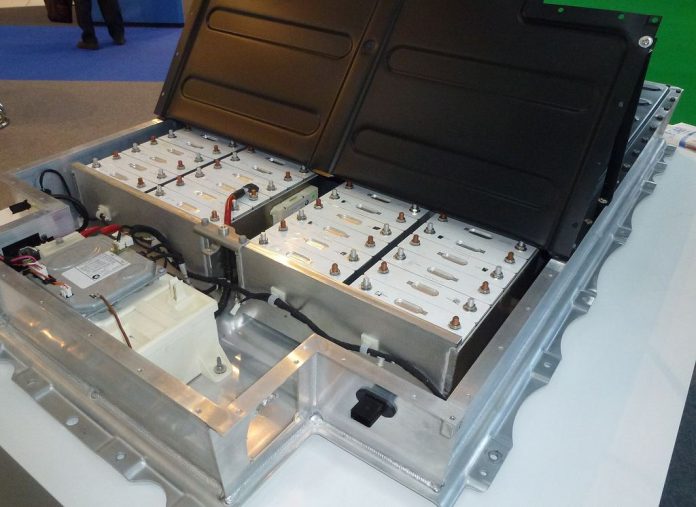
Image: Lithium-Ion Battery for BMW i3 – Battery Pack by RudolfSimon, licensed under CC BY-SA 3.0.