
As Haryana prepares to introduce its state-level Green Hydrogen Policy, industrial developers and plant engineers must look beyond high-level targets. Haryana presents a distinct technoeconomic environment for clean hydrogen production. As a landlocked, industrial, and water-stressed state, its policy framework must address specific physical constraints: high land costs, variable solar-heavy renewable profiles, and strict groundwater extraction limits. Translating draft policy objectives into bankable megawatt-scale production assets requires deep evaluation of stack technology, power electronics, and balance-of-plant (BOP) integration.
The Upstream Power Integration Challenge
The unit economics of green hydrogen are dominated by levelized cost of electricity (LCOE), which accounts for 65% to 75% of overall production cost. Standard draft policies typically offer intra-state transmission charge waivers and energy banking provisions. However, process engineers must design for the physical realities of supply fluctuation and grid interconnect rules.
To achieve commercial viability, a water electrolyzer plant must maintain a high Capacity Utilization Factor (CUF), ideally exceeding 70%. In a solar-dominant generation state like Haryana, relying solely on local photovoltaic (PV) generation yields a CUF of only 22% to 26%. This creates severe operational inefficiencies for the electrolyzer system:
- Dynamic Degradation: Frequent ramping and start-stop cycles accelerate degradation in Proton Exchange Membrane (PEM) catalyst layers and cause accelerated gas cross-over in Alkaline Electrolyzer (AEL) diaphragms.
- Harmonics and Power Quality: Multi-megawatt Thyristor or Insulated Gate Bipolar Transistor (IGBT) rectifiers convert incoming AC grid voltage down to DC stack voltages. High Total Harmonic Distortion (THD) and low power factor at partial load trigger penalties from state utilities if active filtering is omitted.
- Banking Mechanics: Utilizing state grid banking requires aligning the electrolyzer’s continuous load profile with time-of-day tariffs and wheeling losses (typically 3.5% to 5% at 66 kV or 132 kV levels).
“Commercial viability is not achieved by installing stack capacity; it is won by optimizing the continuous kilowatt-hour to kilogram conversion efficiency under real-world grid intermittency.”
Electrolyzer Architecture Selection for Haryana’s Industrial Hubs
Selecting the optimal electrolyzer chemistry depends on the specific industrial cluster in Haryana—whether supplying petroleum hydrotreating units in Panipat, green steel direct reduced iron (DRI) processes in Hisar, or blending into urban gas networks along the Western Peripheral Expressway.
Alkaline Electrolysis (AEL)
AEL remains the lowest CAPEX option (800/kW at the system level). Utilizing potassium hydroxide (KOH) liquid electrolyte, it operates at lower current densities (0.2–0.6 A/cm2) and working pressures under 30 bar. Its primary constraint in dynamic power environments is its limited turndown ratio (typically 20% to 100% of nominal load). Operating below 20% risks hydrogen-in-oxygen crossover reaching unsafe lower explosive limits (LEL).
Proton Exchange Membrane (PEM)
PEM systems feature high current densities (1.5–3.0 A/cm2) and rapid dynamic response times in the millisecond range, making them ideal for direct coupling with un-buffered renewable feed. They produce H2 at elevated pressures (30–80 bar direct stack discharge), reducing downstream mechanical compression energy. However, stack replacement costs remain higher due to precious metal catalysts (iridium and platinum).
Solid Oxide Electrolysis (SOEC)
For high-temperature industrial environments such as refineries or ammonia synthesis plants, SOEC offers high electrical efficiency. By utilizing industrial waste heat (at 650–850°C) to generate steam feed, electrical energy consumption drops from the typical 50–55 kWh/kg H2 seen in ambient systems down to 38–43 kWh/kg H2.
The Water Treatment Bottleneck in Water-Stressed Zones
A critical engineering boundary that is frequently under-scoped in initial feasibility studies is the raw water pretreatment train. Direct stoichiometry requires 8.94 liters of ultrapure water per kilogram of hydrogen produced:
2 H2O (l) → 2 H2 (g) + O2 (g)
However, real-world plant water withdrawal is substantially higher. Taking into account feed water purges, cooling tower evaporation, and water treatment system reject streams, an industrial facility typically consumes 18 to 28 liters of raw water per kilogram of H2.
Because Haryana enforces strict industrial water extraction regulations, green hydrogen facilities must rely on industrial treated effluent or municipal wastewater. Transforming raw feed water into the required ASTM D1193 Type I standard (electrical conductivity <0.056 µS/cm, total organic carbon <50 ppb) demands a multi-stage water treatment system:
- Pre-Filtration: Ultrafiltration (UF) coupled with disc filters to reduce Silt Density Index (SDI) below 3.
- Primary Desalination: Two-pass Reverse Osmosis (RO) with high-recovery membranes to remove >99.2% of dissolved solids.
- Polishing Loop: Continuous Electrodeionization (CEDI) combined with nuclear-grade mixed-bed deionizers to eliminate micro-trace ions that poison catalyst membrane assemblies (MEAs).
- Zero Liquid Discharge (ZLD): Integration of high-efficiency crystallizers and thermal evaporators to process RO brine output, satisfying local environmental discharge norms.
Key Plant Engineering Design Parameters
For engineering teams evaluating upcoming project opportunities under the new policy, the following performance metrics should serve as design baselines:
- Specific Energy Consumption: Target ≤ 52 kWh/kg H2 at the stack boundary, and ≤ 58 kWh/kg H2 at the total plant boundary (inclusive of water treatment, rectifiers, and 30-bar compression BOP).
- Cooling Infrastructure: Electrolysis rejects approximately 15% to 25% of total input electrical energy as low-grade heat (50–70°C). Air-cooled heat exchangers or closed-loop evaporative cooling towers must be sized for peak summer ambient conditions (>45°C in Haryana).
- Gas Purification (DeOxo Units): Raw H2 off-gas containing residual oxygen must pass through catalytic palladium DeOxo reactors and temperature swing adsorption (TSA) dryers to achieve fuel-cell grade purity (>99.97%, ISO 14687 Grade D) with moisture levels below 5 ppm.
- Safety Distances and Area Classification: Hydrogen’s low ignition energy (0.017 mJ) and broad flammability range (4% to 75% in air) require strict compliance with IEC 60079 area classifications. Discharge relief lines must be equipped with active nitrogen purging and flame arrestors.
The upcoming policy will open clear regulatory pathways for project approvals. However, long-term project bankability will depend entirely on sound engineering execution: selecting robust stack configurations, managing complex water treatment flowsheets, and optimizing dynamic power rectifiers.
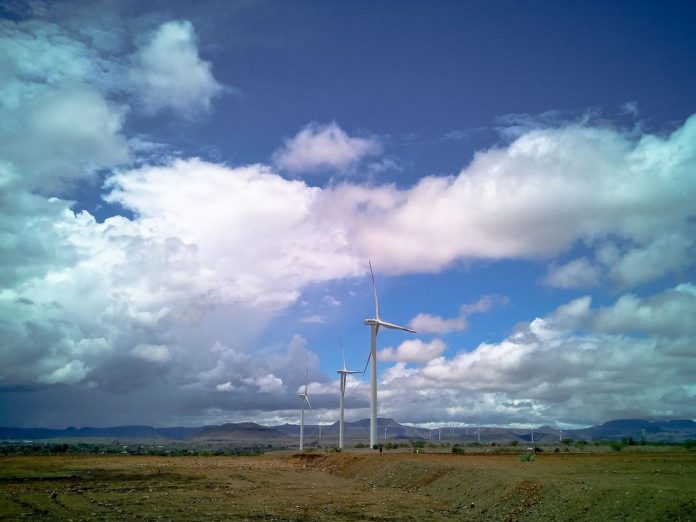
Image: Suzlon Wind Power Farm by SuyogJoshiPhotography, licensed under CC BY-SA 4.0.