
From Diesel-Electric to Fuel Cell Hybridization: The Jind–Sonipat Archetype
The announced trial run of India’s first hydrogen-powered train on the 89-kilometer Jind–Sonipat section in Haryana marks a pivotal transition point for regional passenger transit. By electing to retrofit existing Diesel Electric Multiple Units (DEMUs) under the “Hydrogen for Heritage” framework, Indian Railways is attempting to bypass the heavy capital expenditures—typically ranging from 1.5 million per route-kilometer—associated with conventional 25 kV AC overhead line electrification (OHE) on low-density branch lines.
From a propulsion systems perspective, swapping an onboard diesel-alternator set for a Proton Exchange Membrane Fuel Cell (PEMFC) power module combined with a dynamic battery energy storage system (BESS) is far from a drop-in replacement. A diesel generator provides direct, load-following power governed by mechanical or electronic fueling controls. A PEMFC system, while electrochemically efficient, suffers from transient response limits; sudden load spikes can cause reactant starvation at the membrane electrode assembly (MEA), accelerating degradation. Consequently, the retrofitted architecture relies on a hybrid configuration where the PEMFC stack operates primarily as a base-load unit at current densities optimized for maximum stack longevity (typically between 0.6 and 1.2 A/cm2), while a high-rate lithium-ion traction battery handles dynamic acceleration transients and absorbs kinetic energy during regenerative braking.
Onboard Systems Integration: Storage, Mass Balance, and Thermal Constraints
The engineering realities of converting a standard DEMU car into a hydrail power car center around three critical constraints: volumetric energy density, mass allocation, and thermal rejection.
Gaseous hydrogen at 350 bar (35 MPa) exhibits a volumetric energy density of approximately 0.8 kWh/L, compared to roughly 10 kWh/L for standard automotive diesel. Even when utilizing Type IV carbon-fiber-wrapped composite cylinders, storing sufficient fuel onboard within the tight UIC gauge envelope requires mounting gas storage banks on the vehicle roof or sacrificing internal passenger volume. For a standard 4-car DEMU rake operating a typical duty cycle, daily consumption ranges between 250 kg and 350 kg of fuel-grade H2. This necessitates an integrated storage bank capable of delivering gas at regulated manifold pressures (typically reduced to 10–15 bar before reaching the fuel cell anode control block).
“When transitioning from internal combustion to low-temperature fuel cells, thermal management becomes the primary physical bottleneck governing continuous output power.”
Furthermore, managing the thermal balance of a 1 MW scale fuel cell installation presents a significant challenge for rolling stock design. Unlike diesel engines, which reject nearly 60% of their waste heat through high-temperature exhaust gas (400–500°C) and direct radiative loss, a low-temperature PEMFC operating at 65–80°C must reject virtually all non-electrical enthalpy via its liquid cooling circuit. Because the temperature differential (ΔT) between the stack coolant outlet and ambient summer temperatures in Northern India (which often reach 45°C) is minimal (ΔT ≈ 20–35°C), the required radiator surface area and coolant flow rate increase by a factor of two to three compared to an equivalent internal combustion engine. Onboard Balance-of-Plant (BoP) power draw—including variable-speed coolant pumps, cathode air compressors, and radiator fan arrays—can consume up to 12–18% of the gross stack output under peak ambient load conditions.
Upstream Architecture: The Electrolyzer and Water Treatment Nexus
While trackside discussion focuses heavily on the locomotive, the operational viability of any hydrogen rail network rests on the upstream fuel supply chain. Fuel-cell-grade hydrogen must strictly conform to ISO 14687 Grade D specifications. Impurities such as carbon monoxide (CO > 0.2 ppm), total sulfur compounds (> 0.004 ppm), and ammonia (> 0.1 ppm) cause irreversible poisoning of the platinum catalyst layers in the PEMFC MEA, leading to catastrophic cell voltage degradation.
To guarantee this purity profile at scale, green hydrogen production facilities feeding rail refuelers rely on polymer electrolyte membrane or state-of-the-art pressurized alkaline electrolyzer arrays coupled with catalytic deoxyds and pressure swing adsorption (PSA) polishing units. Modern industrial electrolyzer stacks consume approximately 50 to 55 kWh of electrical energy per kilogram of produced H2 at nominal current densities (1.8 to 2.5 A/cm2 for PEM; 0.4 to 0.8 A/cm2 for advanced alkaline).
However, the critical dependency that is frequently underestimated in feasibility studies is the input water treatment plant (WTP). Electrolyzers require ultra-pure water (UPW) to prevent membrane scaling, ion cross-contamination, and catalytic surface passivation:
- Feedstock Purity Requirements: The electrolyzer feed stream must maintain an electrical conductivity below 0.1 µS/cm (resistivity > 10 MΩ·cm), with total organic carbon (TOC) levels under 50 ppb.
- Mass Consumption Metrics: Stoichiometrically, splitting water yields 1 kg of H2 for every 9 kg of H2O. However, accounting for blowdown, RO permeate recovery rates, continuous EDI bleed streams, and upstream pretreatment backwashing, a real-world industrial water treatment facility requires 15 to 22 kg of raw ground or municipal water per kilogram of high-purity H2 output.
- Treatment Sequence: A resilient system footprint consists of multi-media media filtration, active carbon adsorption, twin-pass Reverse Osmosis (RO), and continuous Electrodeionization (EDI) polishing modules.
For a regional hydrogen refueling hub supplying 1,000 kg of H2 daily to support multiple train passes, the dedicated WTP must deliver roughly 10,000 liters of ultra-pure water per day while reliably processing up to 20,000 liters of raw influent under varying seasonal water quality conditions.
Techno-Economic Realities and System-Level Takeaways
For rail systems engineers, the choice between traditional overhead electrification (OHE) and hydrogen fuel cell retrofits comes down to line utilization and capital deployment speed. High-density corridors will always favor standard 25 kV AC overhead wiring due to superior end-to-end electrical efficiency (~85–90% from grid to wheel vs. ~30–35% for green hydrogen generated via electrolysis, compressed, stored, and re-converted to electricity onboard).
However, on non-electrified branch lines, low-density regional feeder tracks, and sensitive heritage routes, the trackside civil works required for overhead lines—tunnel modifications, bridge clearances, and substation installations—are financially unviable. In these scenarios, the hydrogen DEMU retrofit serves as a viable decarbonization pathway. The long-term engineering success of the Jind–Sonipat pilot will not be judged solely on whether the train runs reliably on the track, but on whether the integrated system—from raw water treatment and electrolyzer efficiency down to onboard thermal management—can lower the levelized cost of hydrogen fuel delivery to parity with conventional diesel operation.
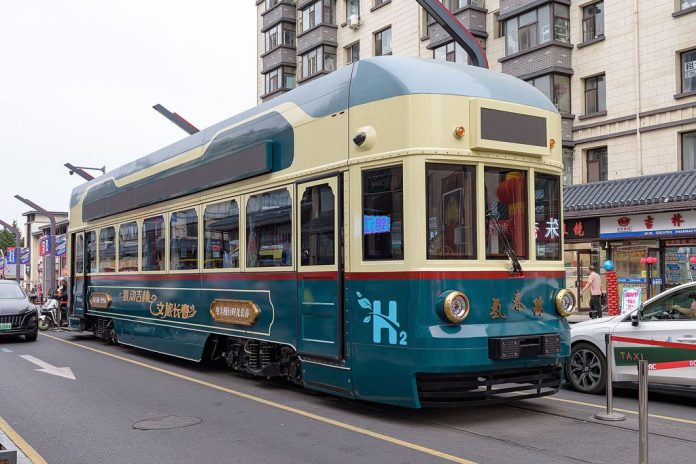
Image: CRRC Changchun hydrogen tram at Hongqi St, Heguang Rd (20250923160259) by N509FZ, licensed under CC BY-SA 4.0.