
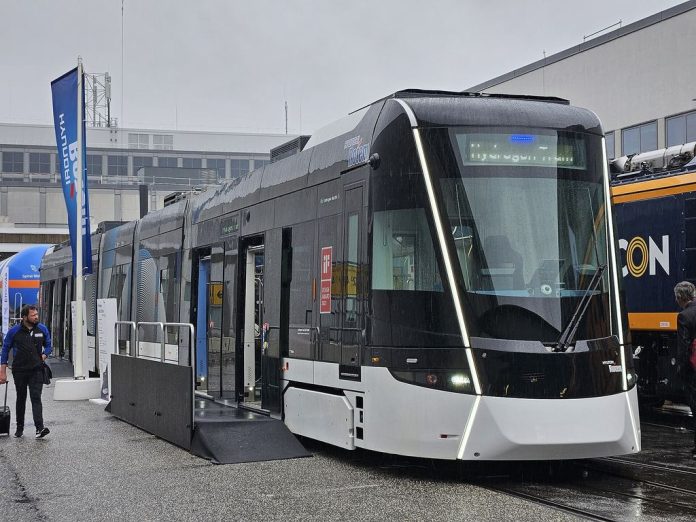

The announcement that Prime Minister Narendra Modi will flag off India’s inaugural hydrogen-powered passenger train under the “Hydrogen for Heritage” initiative marks a notable public milestone for non-electrified regional transit. However, translating this high-profile project into a commercially viable, scalable fleet requires looking past the ceremonial inauguration and examining the underlying electrochemical, thermodynamic, and mechanical realities of heavy rolling stock hybridization.
While retrofitting existing Diesel Multiple Units (DMUs) with fuel cell systems provides an attractive narrative for rapid decarbonization, the physical implementation presents severe engineering constraints. Success depends not merely on mounting fuel cells to rolling stock, but on optimizing the complete power loop—from raw water treatment and electrolyzer feedstocks upstream to dynamic thermal rejection on board.
Propulsion Architecture: PEMFC Hybridization and Thermal Rejection Limits
Standard heavy rail applications demand high power output and rapid dynamic responsiveness during station departures. Proton Exchange Membrane Fuel Cells (PEMFCs) offer high power density and fast cold-start capability, but operating them under harsh transient load profiles accelerates membrane degradation and degrades overall efficiency. To mitigate this, state-of-the-art hydrogen trains employ a hybrid architecture where the PEMFC stack operates at a steady, optimized current density (typically 0.8 to 1.1 A/cm2) to cover the baseline traction load, while a high-discharge traction battery pack handles dynamic peak power demand and absorbs energy during regenerative braking.
From a spatial and structural engineering perspective, retrofitting existing passenger cars requires careful weight distribution and volume management. High-pressure hydrogen storage is generally accommodated on the roof or in a dedicated power car using Type IV carbon-fiber composite cylinders operating at 350 bar. While 700 bar systems are common in light-duty automotive applications, 350 bar remains the industry standard for rail due to lower compression energy overhead, superior volumetric filling speeds, and simpler thermal management during fast refueling cycles.
“The governing physical challenge for fuel cell rail in warm climates is not storage density—it is heat rejection. Operating a PEMFC at 65°C to 75°C when ambient air hits 42°C severely restricts the temperature differential, demanding heat exchangers significantly larger than those found in equivalent diesel locomotives.”
The dominant thermal challenge lies in the narrow temperature difference (ΔT) between the fuel cell coolant circuit and ambient air. While internal combustion engines reject waste heat via exhaust gas and high-temperature coolant loops operating at 95–105°C, a standard low-temperature PEMFC rejects heat predominantly through its liquid cooling system at operating temperatures of 65–75°C. In high-ambient environments (such as Indian summer temperatures exceeding 40°C), the available ΔT for convective heat transfer drops to roughly 25°C. To reject equivalent thermal kilowatts, engineers must install larger radiator surfaces and drive high-capacity electric fans, incurring auxiliary power losses that can degrade net traction efficiency by 3% to 5%.
Upstream Balance of Plant: Ultra-Pure Water Treatment and Electrolyzers
A hydrogen train can only be as clean as its upstream production chain. For localized rail depots serving non-electrified heritage corridors, point-of-use hydrogen generation via water electrolysis avoids the transport losses and capital expenditure of long-distance pipeline or tube-trailer logistics. However, this shifts the engineering burden to the station balance-of-plant (BoP), where water treatment serves as the foundational enabler.
Producing 1 kg of fuel-grade hydrogen through electrolysis requires a theoretical minimum of 8.9 liters of ultra-pure water (H2O). In industrial practice, accounting for reverse osmosis reject streams, electrode cooling blowdown, and system purges, real-world consumption ranges between 18 and 22 liters of raw feed water per kilogram of H2.
Water Purity Standards for Stack Integrity
Both Proton Exchange Membrane (PEM) and Pressurized Alkaline (AEL) electrolyzer stacks are acutely sensitive to water contaminants. Fuel cell-grade hydrogen production demands feed water with electrical conductivity maintained below 0.1 µS/cm and total organic carbon (TOC) under 50 ppb. Trace cations such as iron, calcium, and magnesium rapidly foul membrane electrode assemblies (MEAs) and poison catalyst layers, leading to irreversible cell voltage efficiency decay.
To achieve this, the dedicated water treatment plant must utilize a robust multi-barrier architecture:
1. Pre-treatment & Filtration: Multi-media and activated carbon filtration to remove suspended solids, turbidity, and free chlorine.
2. Reverse Osmosis (RO): Double-pass RO systems to strip 99%+ of total dissolved solids (TDS) and silica.
3. Continuous Electrodeionization (EDI): Polishing via EDI units to achieve 15–18 MΩ·cm water resistivity without the need for hazardous chemical regeneration.
Without an integrated water treatment design, electrolyzer stack life can be reduced by more than 30%, severely undermining the financial model of the refueling depot.
Levelized Cost of Hydrogen (LCOH) and System Efficiency Realities
For hydrogen rail to move beyond subsidized demonstration projects and achieve commercial viability alongside traditional overhead catenary electrification, the levelized cost of delivered hydrogen (LCOH) at the refueling nozzle must target sub-2.00/kg.
Electrolyzer capital cost (CAPEX) currently ranges from 1,000/kW for alkaline systems and 1,400/kW for PEM systems. However, operational expenditure (OPEX) is dominated by renewable electricity tariffs. At a baseline electrolyzer system energy consumption of 52 kWh/kg H2 (inclusive of stack losses and compression to 450 bar storage pressures), the electricity input alone accounts for over 70% of total LCOH.
When comparing Well-to-Wheel (WTW) efficiency, direct overhead catenary electrification remains unmatched, converting 75% to 80% of grid power into mechanical traction at the wheel. By contrast, the green hydrogen pathway—consisting of electrolysis (60–65% HHV efficiency), compression, transport, fuel cell conversion (50–55% efficiency), and drive electronics—yields an overall WTW efficiency of 28% to 34%. Consequently, hydrogen propulsion should not be viewed as a substitute for main-line catenary electrification, but rather as an optimal zero-emission solution for low-density branch lines, remote corridors, and heritage routes where catenary CAPEX (1.8M per kilometer) is economically unviable.
Engineering Guidelines for Implementation
For engineering teams and transport authorities designing next-generation fuel cell rail systems, three design priorities must guide project execution:
1. Optimize Hybrid Power Ratios: Size the PEMFC stack to match average cruising power demand while leveraging high-C-rate lithium-ion batteries (such as Lithium Titanate Oxide, LTO) for transient acceleration and maximum regenerative energy recovery.
2. Design Heavy-Duty Thermal Circuits: Implement microchannel heat exchangers and variable-speed, high-static-pressure cooling fans engineered specifically for high-ambient, low-ΔT operating windows.
3. Co-locate Water Treatment and Electrolysis: Integrate multi-stage EDI water treatment systems directly with depot-side electrolyzer units to ensure strict compliance with ISO 14687 Grade D purity standards, safeguarding stack durability and stabilizing long-term LCOH.
Image: Daejeon-metro-tram-train–built-by-hyundai-rotem–on-innotrans-fair–2024-09-24–picture-by-georgr–cc-by-sa by GeorgR (de), licensed under CC BY-SA 4.0.