
The announcement of Rs 22 Crore (~$2.6 million USD) in targeted government support for India’s initial cohort of green hydrogen startups marks a pragmatic inflection point in national decarbonization policy. While mainstream commentary often focuses on the financial quantum, engineering practitioners must evaluate this funding through the lens of capital efficiency and technological readiness. A funding pool of this scale is not designed to construct gigawatt-scale manufacturing lines; its strategic value lies in de-risking precise, early-stage engineering bottlenecks that currently inflate levelized costs of hydrogen (LCOH).
Bridging the gap between laboratory electrochemical research and reliable, field-deployable pilot units in the 100 kW to 1 MW range requires solving multi-disciplinary problems across fluid dynamics, power conversion, catalyst stabilization, and water purification. For startups and engineering teams working within this ecosystem, maximizing the impact of early-stage capital requires strict focus on core technical parameters.
Where Capital Meets Chemistry: Target Areas for Seed Funding
To maximize return on engineering investment, seed-stage capital must target sub-components that dictate long-term system efficiency and capital expenditure (CapEx). The primary cost drivers and operational failure modes in water electrolysis reside within stack degradation mechanisms and the power conversion interface.
Commercial water electrolysis is currently dominated by Alkaline Water Electrolysis (AWE) and Proton Exchange Membrane (PEM) electrolysis, with Anion Exchange Membrane (AEM) and Solid Oxide Electrolysis Cells (SOEC) representing promising next-generation pathways. Each architecture presents distinct engineering challenges:
1. Noble Metal Reduction and Catalyst Coating
PEM electrolyzers operate at high current densities (1.5 to 2.5 A/cm2) and elevated pressures (30 to 50 bar), but rely heavily on expensive, scarce Platinum Group Metals (PGMs)—specifically iridium oxide (IrO2) at the anode and platinum (Pt) at the cathode. Startups targeting stack optimization must focus on catalyst-coated membrane (CCM) manufacturing techniques that reduce iridium loading below 0.4 mg/cm2 without accelerating voltage degradation beyond target limits (<0.5% performance drop per 1,000 operational hours).
2. AEM Commercialization
Anion Exchange Membrane systems offer the potential to combine the low-cost, non-precious catalysts (such as nickel-iron layered double hydroxides) of alkaline systems with the operational flexibility and high current density (0.8 to 1.5 A/cm2) of PEM stacks. Funding directed toward improving membrane chemical stability against alkaline degradation at operating temperatures above 60 °C addresses one of the major barriers to commercial AEM scale-up.
3. High-Efficiency Power Electronics
Direct current (DC) power delivery accounts for a substantial fraction of overall balance-of-plant costs. Advanced power converter topologies using Silicon Carbide (SiC) or Gallium Nitride (GaN) semiconductors can directly step down high-voltage DC from solar PV or wind buses to the low-voltage, high-current profile required by electrolyzer stacks. Optimizing these converters can eliminate intermediate AC transformer stages, improving overall system electrical efficiency by 3% to 5%.
The Upstream Constraint: Industrial Water Treatment
A critical, yet frequently underestimated operational constraint in green hydrogen production is raw feedstock water purification. Stoichiometrically, splitting water requires 8.94 kg of pure H2O to yield 1 kg of H2 gas. However, when accounting for process losses, cooling requirements, continuous purge streams, and reverse osmosis brine rejection, real-world facilities consume between 18 and 25 kg of fresh water per kg of produced hydrogen.
Electrolyzer stacks require ultra-pure water (UPW) to prevent permanent catalyst and membrane damage. In PEM systems, trace polyvalent cations (such as Ca2+, Mg2+, and Fe3+) at concentrations in the parts-per-billion (ppb) range will competitively displace protons at sulfonic acid exchange sites within the polymer electrolyte membrane. This increases cell internal resistance (Rcell) and accelerates membrane localized thinning.
“An electrolyzer is only as reliable as its water purification train; membrane poisoning due to trace cation breakthrough remains one of the fastest paths to premature stack failure in field installations.”
Feedstock water entering the electrolyzer stack must consistently meet ASTM D1193 Type I or Type II standards, requiring an electrical resistivity greater than 10 to 18 MΩ·cm and Total Organic Carbon (TOC) levels under 50 ppb. Water treatment startups focused on modularizing double-pass Reverse Osmosis (RO) integrated with Continuous Electrodeionization (CEDI) and UV polishing can drastically reduce balance-of-plant complexity while keeping water treatment parasitic energy consumption below 0.5 kWh/kg H2.
Dynamic Response and Variable Renewable Load Cycling
Coupling electrolyzers directly to variable renewable energy (VRE) sources like solar PV and wind introduces severe thermal and mechanical stresses. Electrolyzer plants integrated with off-grid renewable assets face rapid ramp rates, frequent cold and warm starts, and prolonged operation under deep turndown conditions.
In traditional alkaline electrolyzers, operating at turndown levels below 20% of rated capacity presents severe safety risks. At low current densities, gas diffusion across the porous diaphragm increases proportionally relative to production, allowing hydrogen to cross over into the oxygen stream and approach the Lower Explosive Limit (LEL of 4% H2 in O2). While PEM stacks support rapid dynamic response (ramping from 5% to 100% load in sub-second timeframes), rapid pressure differentials (ΔP across the membrane) accelerate mechanical fatigue and pinhole formation in the thin polymer matrix.
Furthermore, thermal management directly affects system-level energy efficiency. While thermodynamic water splitting at standard temperature and pressure requires a minimum energy input of 33.3 kWh/kg H2 (based on Lower Heating Value, LHV), real-world commercial systems operate at 50 to 58 kWh/kg H2 at 30 bar stack outlet pressure. The difference represents thermal losses, power conversion dissipation, and auxiliary equipment loads (pumps, chillers, dryers). Startups developing smart thermal integration—reclaiming waste heat from electrolyzer cooling loops (operating at 65–80 °C) to preheat incoming feedwater or drive thermal water purification—can directly lower total system power consumption by 1.5 to 2.5 kWh/kg H2.
Key Metrics Practitioners Should Monitor
As early-stage green hydrogen startups build out testing rigs and pilot demonstrators under government support programs, engineering teams and project developers should evaluate technological progress using five key performance metrics:
- Stack Cell Voltage: Operating cell voltages below 1.75 V at 2.0 A/cm2 for PEM systems, or below 1.80 V at 0.5 A/cm2 for advanced Alkaline systems (measured at 70 °C).
- System Specific Energy Consumption: Total facility power draw, inclusive of water purification, power electronics, and 30-bar gas compression, targeting ≤ 50 kWh/kg H2.
- Dynamic Degradation Rate: Stack voltage degradation kept below 10 µV/hour under continuous load-cycling profiles representative of solar PV availability.
- Water Treatment Parasitic Ratio: Total raw water demand kept below 20 kg H2O/kg H2 produced, with water treatment energy consumption under 1% of total system power input.
- Balance-of-Plant Skid Modularization: Prefabricated, containerized balance-of-plant designs that minimize site-specific civil works and field piping labor, reducing site integration CapEx by 30% to 40%.
By prioritizing these fundamental engineering metrics over superficial scale metrics, early-stage grant funding can successfully de-risk critical sub-systems, laying a solid foundation for India’s emerging green hydrogen industrial architecture.
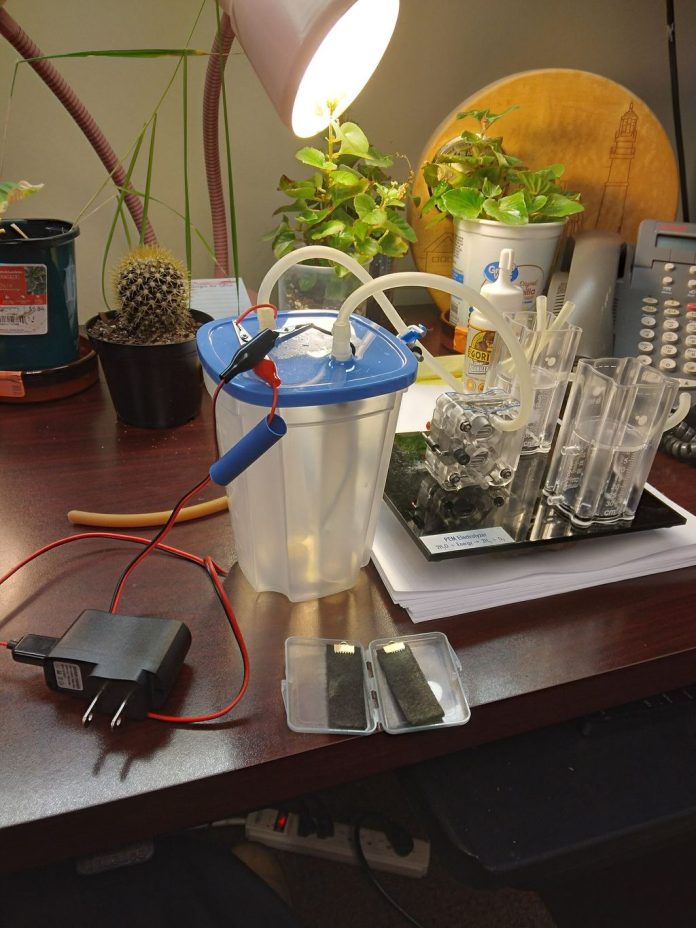
Image: Water Electrolysis Unit Hydrogen Fuel Cell by D.S. Soriano, licensed under CC BY 4.0.