
Deconstructing the Engineering Scope: PEM Technology Meets Solar EPC
As Chief Engineer at Avoltium, when I evaluate commercial green hydrogen deployments, I focus heavily on how system integration bridges the gap between electrolyzer stack specifications and field operation. The collaboration between Ohmium International and InSolare Energy to deliver a multi-application green hydrogen project for NLC India Limited (NLCIL) provides a clear technical template for utility-scale industrial decarbonization in Asia. Rather than viewing an electrolyzer as a standalone unit, this project demonstrates the balance of plant (BOP) engineering required when coupling fluctuating renewable generation with high-current electrochemistry.
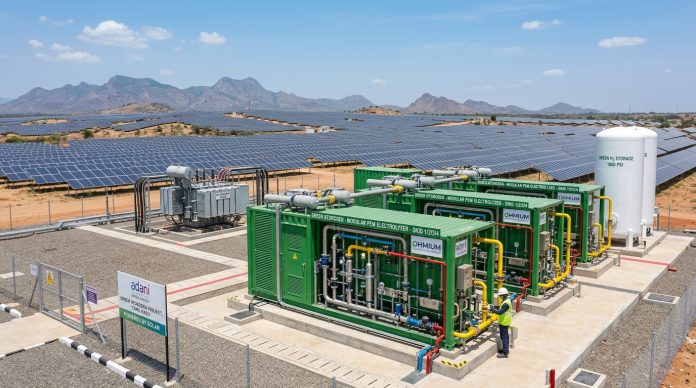
NLCIL, traditionally centered on lignite mining and thermal power generation, is pivoting toward decarbonization by integrating hydrogen into diverse operational streams. The project scope pairs Ohmium’s hyper-modular Proton Exchange Membrane (PEM) electrolyzer units with InSolare’s solar engineering, procurement, and construction (EPC) and electrical balance-of-plant architecture. Multi-application projects present distinct process engineering challenges: the plant infrastructure must absorb severe DC power fluctuations from solar PV output while concurrently delivering high-purity hydrogen gas at steady delivery pressures across distinct end-uses, ranging from thermal power co-firing to mobility fuel cell supplies.
Electrolyzer Stack Dynamics and Industrial Water Treatment Integration
At the center of this facility is Ohmium’s PEM electrolyzer technology, designed to operate at nominal current densities between 1.5 A/cm2 and 2.5 A/cm2. PEM technology holds significant structural advantages over conventional Alkaline Electrolysis (AEL) when paired with solar power. PEM cell stacks offer fast dynamic ramp rates—capable of stepping from 5% turndown to 100% rated capacity in seconds—and maintain high differential pressure operation, routinely generating output pressures of 30 bar directly across the solid polymer membrane. Generating hydrogen at 30 bar within the cell stack removes the primary mechanical compression stage, saving approximately 1.5 to 2.0 kWh/kg H2 in parasite compressor power consumption.
Operating high-current-density PEM stacks creates strict requirements for the supporting water treatment facility. Stoichiometrically, splitting water requires a theoretical minimum of 8.92 liters of pure H2O per kilogram of H2 produced. However, when accounting for cooling tower evaporative losses, continuous system blowdown, and demineralization reject streams, actual plant intake ranges between 18 and 25 liters of raw water per kilogram of hydrogen. Water treatment engineering for PEM electrolyzers cannot tolerate design compromises.
Raw source water must first undergo pretreatment via clarification and media filtration to eliminate suspended solids and organics, followed by a double-pass Reverse Osmosis (RO) system. To protect the PEM catalyst layer, the permeate must pass through Electrodeionization (EDI) or polished mixed-bed ion exchangers. The incoming feed water stream to the electrolyzer stack must maintain continuous electrical conductivity below 0.1 µS/cm and Total Organic Carbon (TOC) levels below 50 ppb. Trace divalent cations, such as Ca2+, Mg2+, or Fe2+, will rapidly foul the iridium ruthenium oxide anode and platinum cathode catalysts on the Membrane Electrode Assembly (MEA), causing irreversible stack degradation and voltage drift within thousands of operating hours.
“The primary operational bottleneck in variable green hydrogen production is rarely the electrochemical cell stack itself, but rather the thermal and hydraulic management systems struggling to follow transient solar power ramps.”
Power Conditioning, Microgrid Stability, and Thermal Constraints
Interfacing the electrolyzer asset directly with solar PV arrays via InSolare’s balance-of-plant design requires optimized power electronics. Solar irradiance curves introduce power quality challenges, including rapid voltage swings, frequency variations, and localized harmonic distortion during cloud passage. PEM stacks demand high-quality, ripple-free Direct Current (DC). High DC current ripple (exceeding 3–5%) induces additional parasitic Joule heating (I2R losses) within the cells and accelerates catalyst dissolution, reducing stack operating lifetime.
The electrical BOP relies on multi-pulse thyristor or IGBT-based Active Front End (AFE) rectifiers, often operating in tandem with high-efficiency buck-boost DC-DC converters to match the PV array array operating voltage to the stack manifold requirement. While individual electrolyzer stack efficiency (η) often appears higher at low partial load due to reduced ohmic overpotential across the membrane, system-level efficiency can deteriorate at extreme turndown. Auxiliary loads—including high-pressure water pumps, cooling loops, process chillers, and control electronics—maintain continuous base load draws, raising overall specific energy consumption if the facility stays at low load factors.
Thermal management imposes further engineering constraints. Hydrogen generation via electrolysis is exothermic when operated above the thermoneutral cell voltage (~1.48 V per cell at 25 °C). Commercial PEM stacks operate at cell voltages between 1.8 V and 2.1 V, releasing significant thermal energy that must be rejected. The liquid cooling loop must actively modulate flow rates to maintain stack internal temperatures strictly within the operating envelope of 55 °C to 75 °C. Rapid thermal cycling causes differential expansion between the titanium bipolar plates, gas diffusion layers (GDL), and delicate fluoropolymer membranes, increasing the risk of mechanical degradation and gas cross-over seal failure.
Multi-Application Gas Purification and Buffer Storage Engineering
NLCIL’s intention to utilize green hydrogen across multiple applications introduces complex downstream processing requirements. Raw hydrogen leaving the PEM stack balance of plant at 30 bar is saturated with moisture and typically carries small amounts of oxygen (0.1% to 0.5% O2 by volume) due to gas crossover through the membrane.
For applications such as power plant co-firing, this raw output may require basic moisture knockout. However, for high-purity applications, such as fuel-cell grade transport (ISO 14687 Grade D) or sensitive chemical manufacturing, the crude H2 stream must pass through a deoxidizer reactor (deoxo unit). The deoxo catalyst—typically palladium-based—combines trace O2 with H2 to form water vapor in an exothermic reaction. The gas stream then passes through a dual-bed Temperature Swing Adsorption (TSA) desiccant dryer to bring moisture levels down to under 5 ppm, yielding final gas purities of 99.999% with a dew point below -65 °C.
Downstream storage must manage variable off-take demand. The system utilizes low-pressure buffer vessels operating at 30 to 50 bar to absorb immediate production surges, followed by multi-stage hydraulic ionic liquid or diaphragm compressors capable of boosting storage pressures to 350 bar or 700 bar for distribution networks. Automated distribution manifolds equipped with fast-acting, SIL-2 rated safety instrumented valves ensure pressure isolation across different discharge lines.
Key Metrics to Watch for Commercial Deployments
As practitioners evaluate integrated hydrogen assets built by partnerships like Ohmium and InSolare, several core engineering metrics will determine long-term operating viability:
Specific Energy Consumption: Total plant power consumption—including rectifiers, water treatment units, cooling equipment, and deoxo purification—must stay within 52 to 56 kWh/kg H2 at nominal output to maintain system efficiency above 60% on a Lower Heating Value (LHV) basis.
Stack Degradation Rates: Stack degradation should ideally stay below 1.5 to 2.5 µV/cell per operating hour under intermittent operational duty cycles to ensure an operational lifetime exceeding 60,000 hours before refurbishing the membrane electrode assemblies.
Water Purity Control: Continuous online monitoring of feed water quality must be tied directly to emergency shutdown loops. If water conductivity rises above 0.2 µS/cm, automated dump valves must immediately bypass feed water away from the electrolyzer manifold to prevent stack contamination.
Achieving bankable green hydrogen systems relies on this level of integration engineering. By managing the interdependencies between renewable power conversion, water purification, electrochemical kinetics, and gas conditioning, projects like NLCIL’s provide a reliable framework for utility-scale industrial transition.
Image: Solnova Solar Power Station by kallerna, licensed under CC BY-SA 4.0.