
The rapid expansion of global offshore wind targets—scaling from tens of gigawatts toward multi-hundred-gigawatt installed capacities over the coming decade—is frequently framed as a commercial opportunity for oil and gas companies seeking portfolio diversification. The structural synergies are undeniable: floating substructures (semi-submersibles, SPARs, tension-leg platforms), heavy-lift vessel operations, geotechnical seabed profiling, and offshore HSE frameworks transfer directly from deepwater hydrocarbon operations to marine renewables. However, viewing offshore wind merely as an alternative method for generating grid-connected electron flows misses a fundamental engineering pivot. As wind developments move further offshore into deeper waters—exceeding 80 to 100 kilometers from shore—the capital expenditure and electrical line losses of High-Voltage Direct Current (HVDC) transmission cables become severe project bottlenecks. The true technical frontier lies in converting variable offshore wind directly into green hydrogen at the platform level, using integrated power-to-gas architectures.
Electrolyzer Architecture and Marine Platform Dynamics
Integrating chemical production directly onto floating or fixed marine structures requires a fundamental re-evaluation of electrolyzer selection and plant design. Onshore hydrogen facilities frequently utilize Alkaline Electrolysis (AEL) due to lower capital costs. Offshore, however, Proton Exchange Membrane (PEM) electrolysis is the primary candidate due to three critical engineering parameters: power density, dynamic response, and physical footprint.
PEM electrolyzers operate at current densities ranging from 1.8 to 2.5 A/cm2, compared to typical AEL operating ranges of 0.4 to 0.6 A/cm2. This translates to a footprint requirement of approximately 0.04 m2/kW at the stack level for PEM systems, delivering a compact cell stack essential for constrained platform topsides. Furthermore, PEM systems can ramp from 5% to 120% of nominal load within seconds, accommodating the unmitigated variable power profiles generated by direct-drive offshore wind turbines without requiring massive battery buffer banks.
At the stack level, modern industrial PEM electrolyzers achieve a specific energy consumption of 50 to 55 kWh/kg H2 (based on the lower heating value of hydrogen). When incorporating auxiliary system loads—including transformer-rectifiers, cooling loops, balance-of-plant pumps, and gas purification—system-level consumption typically reaches 60 to 65 kWh/kg H2.
Designing these process plants for offshore environments introduces severe mechanical challenges. Platform pitch, roll, and heave forces alter phase separation dynamics in gas-liquid separation vessels. Standard gravity-based separation columns must be replaced with structured packing, mist eliminators, or active mechanical separation loops to prevent liquid entrainment in the oxygen and hydrogen discharge streams during sea state motion exceeding 5° dynamic tilt.
The Water Treatment Train: From Seawater to ASTM Type I Feedstock
A frequently underestimated operational aspect of offshore hydrogen generation is the feedstock purification process. Polymer electrolyte membranes require continuous feed water that strictly meets ASTM Type I or Type II ultra-pure water standards. Conductivity must be maintained below 0.1 µS/cm, with Total Organic Carbon (TOC) levels under 50 ppb, and metallic cation concentrations (such as Fe, Cu, Ni, and Na) restricted to sub-ppb levels.
“While seawater desalination consumes less than 0.1% of an offshore green hydrogen facility’s energy budget, a single failure in water polishing can cause catastrophic, unrecoverable electrolyzer stack degradation within hours.”
Stoichiometrically, the splitting of water requires 8.93 kg of pure H2O per 1 kg of H2 produced. However, process efficiencies, reject streams, and backwashing cycles dictate that an offshore facility must harvest approximately 15 to 20 kg of raw seawater per kilogram of produced hydrogen. The multi-stage water treatment train required to achieve this purity on a marine platform typically includes:
- Intake and Pre-treatment: Coarse straining and electro-chlorination to prevent marine biofouling, followed by multi-media filtration or ultrafiltration (UF) membranes to remove suspended solids and silt density index (SDI) components.
- Primary Desalination: A two-pass Reverse Osmosis (RO) system. The first pass (Seawater RO operating at 60 to 80 bar) reduces Total Dissolved Solids (TDS) from ~35,000 ppm down to <500 ppm. The second pass (Brackish Water RO) further reduces TDS to <10 ppm.
- Polishing and Demineralization: Continuous Electrodeionization (CEDI) combined with mixed-bed ion exchange resin polishers to eliminate residual silica, dissolved gases, and trace ions, yielding a final product water conductivity of <0.055 µS/cm at 25 °C.
The energy requirement for this complete water treatment system is remarkably low—roughly 0.03 to 0.05 kWh per kg of H2 produced, representing less than 0.1% of the overall electrical consumption of the electrolyzer. However, the operational risk is asymmetric. Trace breakthroughs of chloride or sodium ions across membrane defect sites cause immediate, irreversible poisoning of the platinum and iridium catalyst layers within the electrolyzer stacks, leading to cell voltage spikes and premature cell failure.
Balance-of-Plant, Gas Compression, and Pipeline Logistics
Beyond stack performance and feed water treatment, balance-of-plant (BoP) engineering determines the technical viability of offshore power-to-gas concepts. Once generated at 30 bar stack pressure, wet hydrogen gas saturated with water vapor must undergo deoxygenation (using catalytic deOXo units to reduce trace O2 content below 5 ppm) followed by Temperature Swing Adsorption (TSA) drying to lower the atmospheric dew point below -70 °C.
Cooling demands are equally substantial. Electrolyzers convert roughly 30% to 35% of input electrical power into low-grade waste heat (~15 to 20 kWh per kg H2). Rejecting this thermal load on a floating offshore asset requires primary closed-loop demineralized water circuits interfaced via titanium plate heat exchangers to open-loop seawater cooling systems.
Energy Transport Economics: Pipeline vs. HVDC Cable
From an infrastructure perspective, transporting energy to shore via gas pipeline is significantly more cost-effective over long distances than electrical transmission. Subsea HVDC cables face high capital costs (often 4.0M per kilometer including installation) and electrical losses of 2% to 4% per 100 km, alongside converter station expenses. Conversely, a subsea carbon steel hydrogen pipeline (with internal polymeric or clad liners to prevent hydrogen embrittlement) can carry multiple gigawatts of equivalent energy at operating pressures of 80 to 100 bar with minimal pressure drop over hundreds of kilometers, operating as an integrated energy storage reservoir (linepack).
Strategic Takeaways for Practitioners
For engineering teams transitioning from conventional offshore energy into the renewables sector, offshore hydrogen production represents a synthesis of marine structural mechanics and chemical process engineering. Maximizing system performance requires focus across three core areas:
- Tightly Integrated BoP Modules: Standardizing skid-mounted, containerized PEM arrays and pre-commissioned water treatment trains optimized for dynamic motion and marine atmospheric corrosion resistance (C5-M specification).
- Dynamic Process Simulation: Developing coupled control models that link fluctuating wind power dynamics directly to high-power DC rectifiers, water feed dosing pumps, and CEDI polishing currents without introducing mechanical stress spikes in the electrolyzer stack.
- Strict Feedwater Assurance: Implementing continuous, redundant online analytical instruments (measuring total organic carbon, dissolved silica, and conductivity) with automatic high-speed shutoff valves to shield stack catalysts from seawater contamination events.
By shifting focus from pure offshore electrical generation to integrated offshore process plants, engineering teams can bridge the gap between variable marine wind resources and reliable, transportable green molecules.
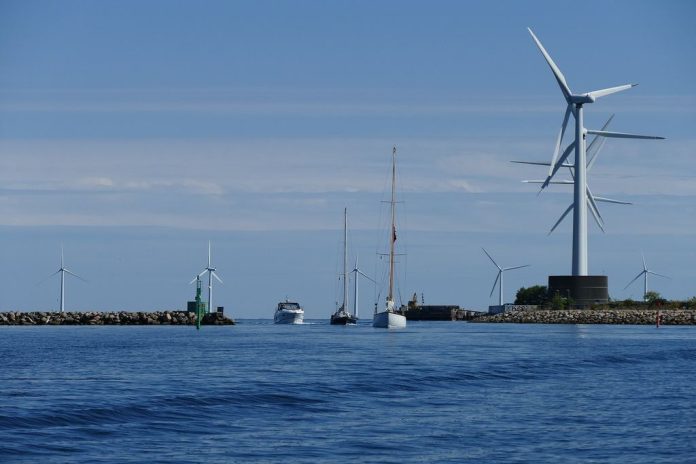
Image: Middelgrunden offshore wind farm 03 by Kritzolina, licensed under CC BY-SA 4.0.