
India’s discovered ₹279/kg ($3.35/kg) green hydrogen threshold proves that sub-₹3.00/kWh dedicated solar power coupled with optimized balance-of-plant (BOP) delivers commercial parity against imported LNG. For plant engineers, Maruti Suzuki’s 300 kW pilot demonstrates how direct furnace blending bypasses pipeline transport losses to de-risk immediate capital deployments.
India’s green hydrogen ecosystem took a dual operational leap forward today. In New Delhi at the Horizons Clean Energy Expansion India 2026 conference, Union Minister for New and Renewable Energy, Pralhad Joshi, officially revealed discovered benchmark market pricing: ₹279 per kilogram for green hydrogen and ₹49.75 per kilogram for green ammonia. Almost simultaneously, automotive leader Maruti Suzuki announced the commercial commissioning of its first 300 kW pilot green hydrogen electrolyzer system at its flagship Manesar manufacturing facility.
The ₹279/kg figure is not merely a political projection—it represents the actual bidding discovery level under the National Green Hydrogen Mission’s Strategic Interventions for Green Hydrogen Transition (SIGHT) scheme. When translated to energy equivalence, ₹279/kg places electrolytic hydrogen at roughly $24/MMBtu, closing the economic gap against delivered spot liquefied natural gas (LNG) in northern industrial corridors.
Inside the Manesar 300 kW Electrolyzer Setup
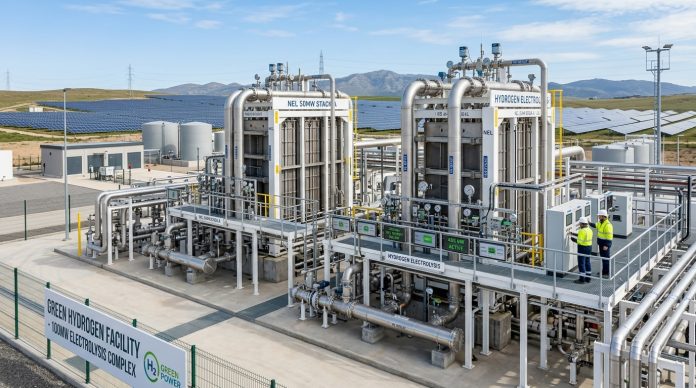
Maruti Suzuki’s deployment at Manesar highlights a practical engineering strategy: on-site distributed generation. Rather than waiting for interstate pipeline networks or ammonia cracking terminals, the automaker has paired a 300 kW pressurized electrolyzer array directly with its on-site captive solar park.
In manufacturing plants, high-temperature thermal furnaces require clean, consistent heat for heat treatment and paint baking. By injecting green hydrogen at a 5% to 10% volumetric blend directly into existing natural gas pipelines, the facility achieves three immediate operational milestones:
- Zero Burner Retrofit: Operating under a 10% hydrogen blend requires zero burner nozzle redesign, eliminating flash-back risks and avoiding expensive metallurgy overhauls.
- Avoided Transport Compression: On-site generation at 30 bar eliminates the 200–350 bar tube-trailer compression stage, cutting auxiliary electricity losses by nearly 1.8 kWh per kg of H2.
- Variable Solar Absorption: The electrolyzer dynamically ramps output to track midday solar peaks, buffering excess electricity that would otherwise face curtailment.
Inside the 300 kW stack, direct current (DC) drives the Hydrogen Evolution Reaction (HER: 2H2O + 2e– → H2 + 2OH–) at the cathode while hydroxide ions migrate across a Zirfon-based porous diaphragm to drive the Oxygen Evolution Reaction (OER: 2OH– → ½O2 + H2O + 2e–) at the nickel-mesh anode. A recirculating 28 wt% potassium hydroxide (KOH) lye loop maintains thermal equilibrium at 75°C. Product gas passes through a dedicated gas-liquid separator, a catalytic de-ox unit reducing residual O2 below 5 ppm, and dual-column desiccant dryers to achieve industrial furnace purity.
Decurving the Levelized Cost: How ₹279/kg is Achieved
From a capital expenditure standpoint, achieving ₹279/kg requires strict alignment between three operational levers: electricity tariff, stack specific power consumption, and operating hours. You can model these exact sensitivities on our interactive LCOH Calculator.
“The real engineering battle in green hydrogen isn’t catalyst loading—it’s power conditioning efficiency and cooling water quality. Solve those two, and your levelized cost plummets below $3.50/kg.”
(Eq. 1)
| Symbol | Description | Indian Benchmark Range |
|---|---|---|
| LCOH | Levelized Cost of Produced Hydrogen | ₹270 – ₹310 / kg |
| CAPEX | Electrolyzer + BOP Capital Cost | $650 – $800 / kW (Alkaline) |
| SEC | Specific Energy Consumption | 50 – 54 kWh / kg H2 |
| Pelec | Delivered Renewable Electricity Tariff | ₹2.40 – ₹3.20 / kWh |
| Cwater | Ultrapure Deionized Water & Cooling | ₹2.50 – ₹4.00 / kg H2 |
The Water Demand: 9 Liters Pure Feedstock per Kilogram
Every kilogram of hydrogen split requires exactly 8.92 kilograms (liters) of stoichiometric pure water, but in practice industrial plants require 18 to 22 liters of raw source water to account for reverse osmosis (RO) reject brine and cooling evaporation. Ensuring adequate pretreatment is vital to prevent calcium, silica, and chloride fouling on stack electrodes. You can estimate plant water flows using our Water Consumption & Treatment Calculator.
With India targeting 5 million metric tonnes (MMT) of green hydrogen production annually by 2030, industrial projects will require approximately 90 to 110 million cubic meters of treated water annually. Facilities like Maruti’s Manesar plant are addressing this by integrating effluent treatment plant (ETP) recycling loops into electro-deionization (EDI) polishers.
Strategic Takeaways for Plant Developers
As state policies roll out across Gujarat, Maharashtra, and now Bihar with its pending ₹16,000 crore roadmap, developers must focus on three commercial rules:
- Prioritize High CUF Hybrid Power: Relying on standalone solar leaves your electrolyzer operating at a 22% capacity utilization factor (CUF), driving up CAPEX amortization per kg. Hybrid wind-solar agreements raise CUF above 60%, immediately shaving ₹40/kg off the LCOH.
- Scale Modular Balance of Plant: Sizing rectifiers, gas purifiers, and demineralized water skids in modular 5 MW to 10 MW increments lowers maintenance downtime and simplifies replacement cycles.
- Track GHCI Compliance: Ensure emission tracking meets the Ministry of New and Renewable Energy’s newly launched Green Hydrogen Certification Scheme of India (GHCI) threshold of ≤ 2 kg CO2e per kg H2 to qualify for export and carbon credit credits.