
As the Chief Engineer at Avoltium, I have overseen the deployment of numerous multi-megawatt green hydrogen production facilities globally. The transition from engineering design to commercial operation is arguably the most critical lifecycle phase for any industrial electrolyzer plant. Commissioning is not merely a checklist of start-up activities; it is a systematic validation of multi-physics systems encompassing electrochemistry, high-pressure fluid dynamics, power electronics, and sophisticated safety interlocks. Ensuring a seamless handover requires navigating three distinct, uncompromising testing gates: Factory Acceptance Testing (FAT), Site Acceptance Testing (SAT), and the final Performance Test Protocols (PTP).
The Electrochemistry of Commissioning: Bridging Theory and Industrial Reality
Before examining testing protocols, we must ground our validation framework in the electrochemical kinetics governing modern water splitting technologies, specifically Alkaline Water Electrolysis (AWE) and Proton Exchange Membrane (PEM) systems. The operational voltage of an individual cell is defined by the fundamental relationship:
Vcell = Erev + ηanode + ηcathode + i·Rohmic
During the commissioning phases, every term in this equation is meticulously tested. The reversible cell voltage (Erev) depends on operating temperature and pressure, while the overpotentials (η) and ohmic resistance (Rohmic) dictate the stack’s baseline health and efficiency. Furthermore, the balance of plant (BoP) relies heavily on advanced Water Treatment units to feed demineralized water with a conductivity strictly below 0.1 μS/cm into the system. Introducing substandard water during startup can instantly poison catalysts or degrade membranes via accelerated cation exchange.
“Commissioning an electrolyzer is not about forcing the system to run on day one; it is about proving through quantitative data that every safety envelope, control loop, and thermodynamic parameter performs within engineered tolerances before high-amperage power is ever applied.”
Phase 1: Factory Acceptance Testing (FAT) — Validating the Core
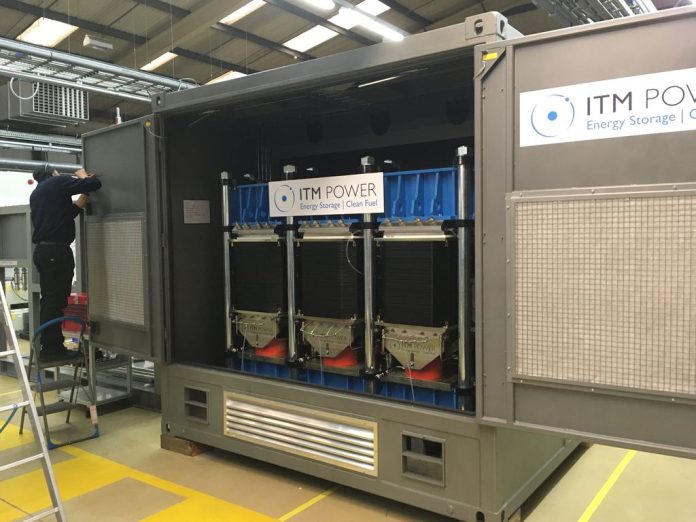
Factory Acceptance Testing represents the first major milestone, executed within the controlled environment of the OEM manufacturing facility. For an electrolyzer plant, FAT focuses primarily on the stack modules, power control systems, and skid-mounted BoP assemblies prior to field dispatch.
Power Electronics and Rectifier Verification
The high-current rectifiers supplying DC power to the electrolyzer stacks must undergo comprehensive load testing. At Avoltium, our FAT protocols require testing rectifiers up to 100% rated capacity using resistive load banks. We evaluate total harmonic distortion (THD) on the AC supply side, ripple currents on the DC output (which must remain below 2% to prevent localized hot spots and accelerated catalyst degradation), and the sub-cycle response times of the emergency fast-discharge circuits.
Safety Instrumented Systems (SIS) and Control Logic
The safety of a hydrogen facility hinges on the integrity of the Safety Instrumented System (SIS). During FAT, loop checking and cause-and-effect matrix verification are performed exhaustively. Every sensor—ranging from hydrogen-in-oxygen (% v/v) analyzers to differential pressure transmitters across the membrane or diaphragm—is subjected to simulated failure modes and out-of-range inputs to verify that safety integrity level (SIL-2 or SIL-3) interlocks trip the plant within milliseconds.
Hydrostatic and pneumatic pressure testing of all piping, pressure vessels, and gas-liquid separation drums is conducted in accordance with ASME or PED standards. Pneumatic leak testing using dry nitrogen or helium leak detection ensures that flange integrity and weld seams can withstand maximum allowable working pressures (MAWP) with zero detectable leakage.
Phase 2: Site Acceptance Testing (SAT) — Integration and Cold Commissioning
Once equipment arrives on-site and mechanical/electrical erection is complete, Site Acceptance Testing begins. SAT bridges the gap between individual component FAT and integrated plant operations. This phase is divided into mechanical completion checks, electrical loop validation, and “cold” commissioning.
Water Treatment and Purity Validation
Because the anode and cathode reactions depend strictly on high-purity feedstocks, the on-site Water Treatment plant is commissioned first. Reverse osmosis (RO) units, electrodeionization (EDI) columns, and polishing beds are flushed, sanitized, and tested. We monitor incoming conductivity, total organic carbon (TOC), and silica levels continuously. Only when the Water Treatment output consistently demonstrates a resistivity of 18.2 MΩ·cm at 25 °C is water permitted to fill the electrolyzer stack loops.
Dry Runs and Interlock Validation
Cold commissioning involves energizing control panels, calibrating all field instrumentation in situ, and performing dry runs of all actuated valves, pumps, and compressors without applying DC power to the stacks. Emergency shutdown (ESD) buttons are manually activated to test the complete depressurization sequence, nitrogen purge purging cycles, and isolation valve closures. The target is to confirm that the plant can transition from full production to a safe, inert state autonomously.
“The success of a site integration is measured by how smoothly the control philosophy translates from the digital twin into physical reality, ensuring that every valve, pump, and sensor responds harmoniously under pressure.”
Phase 3: Performance Test Protocols (PTP) — Hot Commissioning and Guarantee Verification
The culmination of the commissioning journey is the Performance Test Protocol (PTP), often referred to as hot commissioning. This phase involves introducing electrical current to the electrolyzer stacks, generating real hydrogen (H2) and oxygen (O2), and operating the plant continuously to verify performance against contractual guarantees.
Stack Conditioning and Polarization Curves
Initial power application requires a controlled current ramp-up to condition the electrodes and membranes. During this period, field engineers construct experimental polarization curves by plotting cell voltage against current density (i = I / A, measured in A/cm2). By comparing these site-derived curves against factory baselines, engineers can instantly detect any transport polarization limitations or ohmic resistance anomalies induced during transport and installation.
Efficiency calculations are rigorously executed during the PTP. The system’s specific energy consumption (SEC) is evaluated using the higher heating value (HHV) or lower heating value (LHV) of hydrogen:
Efficiency = (ΔG / Pinput) × 100%
Contractual guarantees typically mandate that specific energy consumption remains below a specified threshold, such as 52 kWh/kg of H2 produced at nominal capacity, inclusive of all parasitic loads from the BoP, cooling systems, and Water Treatment facilities.
Purity, Pressure, and Dynamic Load Testing
Gas quality is a critical deliverable of the PTP. Online gas chromatographs and electrochemical sensors must verify that hydrogen purity exceeds 99.9% dry basis prior to downstream compression and storage. Concurrently, oxygen-in-hydrogen purity must remain safely below the flammability threshold (traditionally under 1.5% v/v, with hard trips set at 2.0% v/v). Dynamic load testing is then initiated, ramping the plant from 20% to 100% load within seconds to demonstrate fast-response capabilities required for coupling with fluctuating renewable energy sources like wind and solar.
Documentation, Handover, and Lifecycle Operations
The commissioning process concludes only when all PTP data has been thoroughly analyzed, certified by independent engineers, and compiled into a comprehensive turnover package. This documentation includes calibrated instrument sheets, as-built piping and instrumentation diagrams (P&IDs), software backup files, and baseline degradation logs.
At Avoltium, we treat the final handover not as an endpoint, but as the foundation of a long-term operational partnership. By executing rigorous FAT, SAT, and PTP protocols, we eliminate latent defects, optimize thermodynamic efficiency, and guarantee that every electrolyzer plant we deploy operates safely, reliably, and profitably for decades to come.