
Downstream Hydrogen Realities: Bridging Generation and Utilization
At Avoltium, our core engineering objective is the optimization of molecular energy delivery. While significant industry attention focuses on stack efficiency within the electrolyzer, the downstream challenge of hydrogen densification represents the most critical thermodynamic bottleneck in the energy vector. Pure hydrogen generated via water electrolysis possesses an extraordinary lower heating value (LHV) on a mass basis—approximately 120 MJ/kg (33.33 kWh/kg). Yet, at normal temperature and pressure (NTP: 20 °C, 1 atm), its volumetric density is an abysmal 0.089 kg/m3. By comparison, ambient air rests at roughly 1.2 kg/m3, and conventional liquid hydrocarbons exceed 750 kg/m3.
Every commercial utilization scenario—from heavy-duty fuel cell transport to seasonal grid-scale buffering—mandates physical or chemical densification. Achieving this requires traversing steep thermodynamic gradients. Furthermore, gas quality exiting the system is non-negotiable; rigorous upstream water treatment (achieving electrical resistivity > 18.2 MΩ·cm via dual-pass reverse osmosis and continuous electrodeionization) ensures the electrolyzer stack does not pass halogen or mineral impurities downstream, where they could poison catalytic hydrides, foul compression seals, or accelerate embrittlement.
“The ideal gas law is an engineer’s illusion above 200 bar. At transmission pressures, intermolecular repulsive forces exact a severe mass-density penalty that redefines balance-of-plant design.”
1. Compressed Gas Storage (CGH2): Mechanics, Fugacity, and Real-Gas Realities
Compressed gas storage remains the dominant industrial standard due to technological maturity and rapid filling kinetics. Modern architectures have shifted from low-pressure steel vessels (Type I) to advanced fiber-wound composite cylinders (Type III and Type IV):
- Type I: All-metal construction (seamless steel/aluminum). Operating range: 150–250 bar. Poor gravimetric performance (1.0–1.5 wt% H2). Highly prone to hydrogen-induced crack propagation if steel microstructure contains elevated pearlite or sulfur inclusions.
- Type II: Steel or aluminum load-bearing liner hoop-wrapped with resin-impregnated glass or carbon fiber. Moderate weight reduction; limited to stationary applications.
- Type III: Seamless metallic liner (typically Al 6061-T6) wrapped fully with carbon fiber composite in an epoxy matrix. The metallic liner provides both a complete permeation barrier and load sharing (approx. 20–30% of structural mechanical load).
- Type IV: Non-metallic liner—typically blow-molded High-Density Polyethylene (HDPE) or Polyamide (PA6/PA12)—fully wrapped with high-modulus carbon fiber. The polymer liner acts strictly as a permeation bladder, with mechanical tensile loads borne entirely by the carbon fiber winding. Gravimetric densities hit 4.5–6.0 wt% at 700 bar.
From a thermomechanical standpoint, engineers must account for the compressibility factor, Z. Governed by the equation P·V = Z·n·R·T, Z increases significantly above unity as pressures scale beyond 200 bar due to short-range repulsive molecular potentials. At 700 bar (70 MPa) and 15 °C, Z reaches roughly 1.48. Consequently, the actual mass stored is nearly 32% lower than what ideal gas assumptions predict. True density at 700 bar and 15 °C peaks at approximately 40.2 kg/m3, far short of the theoretical 58 kg/m3 computed via elementary equations of state.
Furthermore, fast-fill refueling cycles (SAE J2601) encounter the negative Joule-Thomson coefficient of hydrogen at ambient conditions (inversion temperature is approximately 202 K). Adiabatic expansion through flow restrictors and compressive heating within the vessel causes the internal gas temperature to surge toward its safety ceiling of 85 °C. Mitigating this demands energy-intensive pre-cooling refrigeration chillers operating at -40 °C (T40 rating), imposing an additional balance-of-plant electrical load of 0.8–1.5 kWh/kg H2.
2. Cryogenic Liquid Hydrogen (LH2): The Ortho-Para Paradox and Thermal Isolation
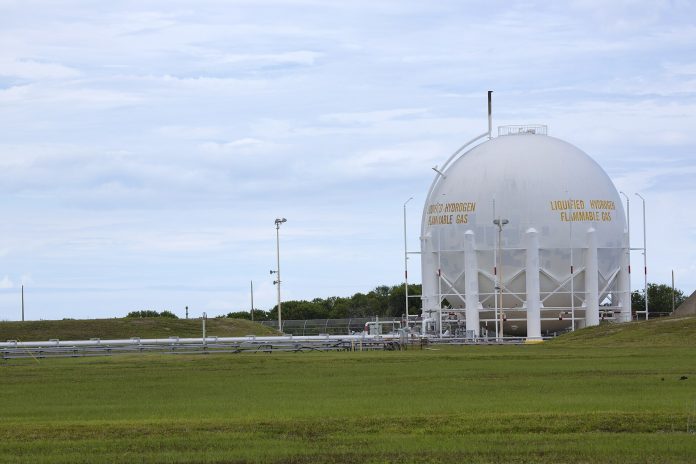
To break through the volumetric ceiling of gaseous storage, liquefaction drops hydrogen down to its atmospheric boiling point of 20.28 K (-252.87 °C). At this state, liquid hydrogen attains a density of 70.8 kg/m3 at 1 atm, offering unmatched volumetric and gravimetric energy profiles for long-distance transport and aerospace duty cycles.
However, the thermodynamics of liquefaction are unforgiving. The theoretical minimum work (exergy change) required to liquefy hydrogen from ambient conditions (1 bar, 298 K) is given by:
Wmin = Δh – T0·Δs ≈ 3.22 kWh/kg H2
In practice, state-of-the-art multi-stage Claude cycle liquefaction facilities operate at 30–35% exergetic efficiency. Real-world electrical inputs range from 8.5 to 12.0 kWh/kg H2. This means that 25% to 36% of the molecule’s lower heating value is consumed purely in the phase-change processing equipment.
“Ignoring the spin-isomer conversion kinetics in cryogenic storage guarantees boil-off failure. The ortho-to-para transition enthalpy easily exceeds the latent heat of vaporization.”
The molecular configuration of hydrogen introduces an additional hurdle: spin-isomerism. Molecular hydrogen exists in two states based on relative nuclear proton spins:
- Ortho-hydrogen: Parallel proton nuclear spins (triplet state, odd rotational quantum numbers). Represents 75% of equilibrium composition at room temperature (known as “normal” hydrogen).
- Para-hydrogen: Antiparallel proton nuclear spins (singlet state, even rotational quantum numbers). Thermodynamically favored at 20 K (>99.8% equilibrium concentration).
The uncatalyzed self-conversion of ortho to para is a second-order process with a slow rate constant (approx. 0.012 per hour). Critically, the heat of conversion is ΔHo-p = 527 kJ/kg, which is significantly greater than the latent heat of vaporization (ΔHvap = 446 kJ/kg). If normal hydrogen is rapidly liquefied without catalytic spin conversion, the slow in-situ conversion releases enough energy within the dewar to vaporize the entire liquid volume over several weeks, irrespective of how sophisticated the vacuum jacket insulation is. Cryogenic facilities must therefore incorporate heterogeneous catalysts—such as hydrous ferric oxide (Fe2O3) or activated chromium oxide (Cr2O3)—directly into intermediate cooling stages.
3. Solid-State Metal Hydrides: Sub-Surface Chemisorption and Reversible Kinetics
Solid-state storage through interstitial metal hydrides trades mass for safety and volume. In these systems, molecular hydrogen dissociates catalytically on the metallic alloy surface and diffuses into the interstitial crystalline lattice sites as elemental hydrogen atoms, forming a metal hydride (MH) phase.
The equilibrium pressure-temperature relationship of hydriding alloys is defined by the classical van ‘t Hoff equation:
ln(Peq / P0) = (ΔH / (R·T)) – (ΔS / R)
Where ΔH represents the enthalpy of formation, ΔS is the entropy of formation (predominantly corresponding to the loss of gaseous entropy of H2, roughly -130 J/(mol·K)), R is the universal gas constant, and Peq is the plateau equilibrium pressure. Depending on the alloy matrix, volumetric densities can reach extraordinary levels (up to 110 kg H2/m3 in Mg2FeH6 or 90 kg H2/m3 in LaNi5H6), vastly exceeding even liquid hydrogen without requiring extreme pressures or deep cryogenics.
Alloy categories diverge significantly in operating regimes:
- Low-Temperature Intermetallics (AB5, AB2, TiFe): Desorb at 0–80 °C and 1–30 bar. Ideal for direct coupling with the balance-of-plant of an electrolyzer, but they suffer from dismal gravimetric capacities (1.2–2.0 wt%).
- High-Temperature Light-Metal Hydrides (MgH2, NaAlH4): Offer high theoretical gravimetric densities (7.6 wt% for pure MgH2). However, high bonding enthalpies (ΔH ≈ 75 kJ/mol) require operating temperatures between 280 °C and 350 °C to achieve an equilibrium desorption pressure of 1 bar.
The engineering challenge shifts fundamentally from vessel wall mechanical stress to internal thermal management. Hydride absorption is violently exothermic; desorption is strictly endothermic. Recharging an AB5 metal hydride bank within a 15-minute timeframe requires an integrated multi-tube heat exchanger capable of removing dozens of kilowatts of thermal energy to prevent the bed from overheating, which would immediately arrest further hydriding via equilibrium backpressure.
Engineering Evaluation & Trade-off Matrix
Selecting an optimal storage vector demands rigorous appraisal of capital expenditure, energy overhead, and installation footprint:
| Parameter | Type IV CGH2 (700 bar) | Liquid H2 (LH2, 1 atm) | Low-Temp Hydride (TiFe / AB5) | High-Temp Hydride (MgH2) |
|---|---|---|---|---|
| Volumetric Density (kg H2/m3) | 38 – 40 | 70.8 | 85 – 105 | 100 – 115 |
| System Gravimetric Density (wt%) | 4.5 – 5.8% | 7.5 – 12.0% | 1.2 – 1.8% | 4.0 – 5.5% |
| Parasitic Energy Input (% LHV) | 12 – 18% (compression) | 28 – 36% (liquefaction) | 5 – 8% (mild heat/pumping) | 22 – 30% (high-grade thermal) |
| Operating Temperature | -40 °C to +85 °C | -253 °C (20.3 K) | 15 °C to 60 °C | 280 °C to 350 °C |
| Dormancy Loss / Boil-off | Zero (negligible permeation) | 0.15 – 1.0% / day | Zero | Zero |
Upstream Interfaces: Electrolyzer Dynamics and Purification Cascades
The boundary conditions of the storage vector invariably dictate the operational profile of the generation plant. When an alkaline or proton exchange membrane (PEM) electrolyzer generates hydrogen, the internal stack pressure ranges from atmospheric up to 35 bar in balanced differential designs. Directly routing this stream into storage systems requires careful purity tracking. In water electrolysis, the performance of the upstream water treatment system is the ultimate arbiter of downstream equipment longevity.
Water treatment architectures must completely eliminate dissolved minerals, total organic carbon (TOC), and silica. If feedwater resistivity slips below threshold standards, ionic transfer across the membrane leads to cross-over contamination, degrading membrane-electrode assemblies and introducing trace moisture and oxygen into the hydrogen gas output. While compressed gas systems can tolerate minor dew point variations using standard desiccant pressure-swing adsorption (PSA) driers, solid-state metal hydrides will permanently passivate if exposed to oxygen, carbon monoxide, or water vapor above 1 ppm levels.
Furthermore, coupling storage directly to a dynamic, variable-load electrolyzer driven by wind or solar assets presents system-level integration complexities. Compressed gas configurations respond rapidly to wide-ranging electrical swings, accepting intermittent mass flows by simply ramping multi-stage reciprocating or ionic liquid compressors. Conversely, cryogenic liquid plants demand stable, continuous baseload operation; rapid cycling of a Claude cycle cold box introduces thermal fatigue across high-speed expansion turbines, triggering automated plant trips. Metal hydride beds introduce an inverse operational challenge: their fill rate is completely decoupled from pressure ratings, bound instead by the external cooling circuit’s heat rejection capabilities.
Strategic Verdict: Application-Driven System Architecture
Engineering has no universal answers, only balanced compromises. For mobility applications where system mass defines the payload boundary—such as Class 8 heavy-duty trucking—Type IV compressed gas at 700 bar remains the pragmatic near-term choice, with cryogenic liquid serving as the ultimate solution for extreme range corridors and long-haul maritime routes.
For decentralized stationary microgrids, behind-the-meter industrial integration, and confined urban setups, the calculus flips. Here, solid-state low-temperature metal hydrides emerge as the safest solution. Operating at pressures below 30 bar, they eliminate explosive blast zones, bypass high mechanical compression penalties, and present an exceptionally low footprint. As we scale megawatt-class electrolyzer installations globally, matching the thermodynamic boundaries of the storage vector to the downstream user is the fundamental metric that separates operational assets from stranded capital.