
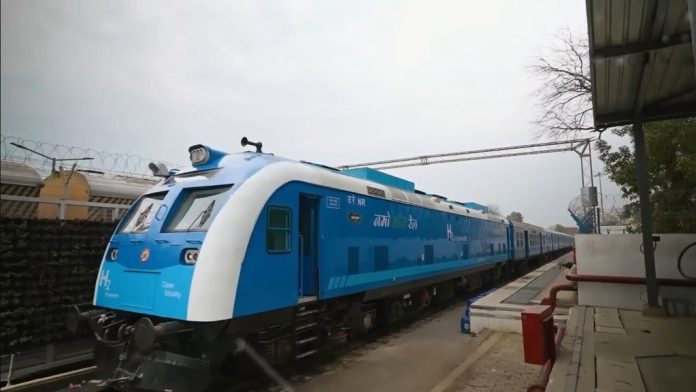

The recent unveiling of India’s first indigenously developed hydrogen-powered train—a prototype converted from a conventional Diesel Electric Multiple Unit (DEMU) platform under the national “Hydrogen for Heritage” push—marks an important milestone for non-electrified regional transit. However, while converting rolling stock to run on Proton Exchange Membrane Fuel Cells (PEMFC) and 350 bar roof-mounted storage demonstrates technical capability, the broader feasibility of hydrail depends on systems engineering far beyond the train body. For plant designers, mechanical engineers, and infrastructure planners, this rollout serves as a practical baseline for examining the physical realities of fuel cell hybridization, upstream electrolyzer integration, and high-purity water supply chains.
Thermodynamic Realities of Onboard Fuel Cell Hybridization
Onboard a hydrogen-powered train, the propulsion architecture must resolve a fundamental mismatch: PEM fuel cells deliver optimal electrical efficiency (50–55% lower heating value) under steady-state loads, whereas passenger rail profiles are defined by high-transient power demands during acceleration and steep gradient climbs. Subjecting a PEMFC stack directly to dynamic load spikes accelerates voltage degradation due to membrane mechanical stress, local reactant starvation, and platinum catalyst dissolution. Operating individual fuel cells continuously at high current densities exceeding 1.5 A/cm2 significantly depresses stack efficiency and increases thermal dissipation burdens.
To preserve stack longevity and maintain system efficiency, modern hydrail designs employ a active-hybrid configuration. In this setup, the fuel cell functions as an onboard base-load power generator, operating within a tight, optimized window (typically at cell voltages between 0.65 V and 0.72 V), while a high-power Lithium Titanate (LTO) or specialized Lithium Iron Phosphate (LFP) energy storage system (ESS) manages dynamic loads. The battery bank handles transient peak power demands—delivering C-rates up to 4C to 6C during acceleration—and captures regenerative braking energy at efficiencies reaching 80–85%. Onboard storage relies on Type-4 carbon-fiber wound composite cylinders operating at a nominal pressure of 350 bar (35 MPa), yielding a volumetric H2 density of roughly 23 kg/m3. While 700 bar systems offer higher volumetric density for passenger light vehicles, 350 bar remains the industry standard for heavy rail due to reduced compression energy requirements, lower mechanical stress cycles during rapid filling, and acceptable spatial envelopes on vehicle roofs.
“The true levelized cost of hydrail operation is rarely won or lost on the bogie; it is determined at the water intake valve and the electrolyzer busbar.”
Upstream Balance-of-Plant: The Water Treatment Imperative
A crucial aspect of fuel-cell transit that receives less attention is the upstream fuel supply chain. Fueling a regional passenger fleet with green hydrogen requires a continuous, high-volume production ecosystem at local depots. Standard PEM fuel cells are extremely sensitive to chemical impurities; trace contaminants such as carbon monoxide (>0.2 ppm), total hydrocarbons, or sulfur compounds (>0.004 ppm) irreversibly poison the platinum-cobalt catalysts on the membrane electrode assembly (MEA). Consequently, generating hydrogen via water electrolysis demands ultra-pure water (UPW) feedwater to ensure fuel quality complies with ISO 14687 Grade D standards.
From an industrial water treatment perspective, producing one kilogram of pure H2 stoichiometrically requires 8.92 liters of pure H2O. However, accounting for balance-of-plant operational losses—including reverse osmosis brine reject, cooling tower blowdown, and electrodeionization (EDI) rinse cycles—the actual water footprint ranges from 18 to 25 liters of raw water per kilogram of dispensed hydrogen. To feed a megawatt-scale Proton Exchange Membrane or Alkaline electrolyzer array, raw water must undergo a comprehensive multi-stage treatment process:
1. Pre-treatment and Clarification
Raw municipal or ground water passes through ultrafiltration (UF) membranes to eliminate suspended solids, colloidal silica, and organic foulants, achieving a Silt Density Index (SDI15) of less than 3.0.
2. Dissolved Solids Removal
A double-pass Reverse Osmosis (RO) system removes over 99.2% of dissolved ions, reducing electrical conductivity from variable raw water levels down to less than 10 µS/cm.
3. Polishing to Ultrapure Standards
Continuous Electrodeionization (CEDI) coupled with mixed-bed ion-exchange polishing resin brings the water to a resistivity of 18.2 MΩ·cm at 25 °C, with dissolved silica levels kept below 5 ppb. Maintaining this extreme purity prevents mineral scaling on electrolyzer titanium porous transport layers and mitigates membrane degradation.
For modular depot installations, integrated water treatment systems must be sized to match electrolyzer consumption rates. A standard 10 MW electrolyzer operating at a specific energy consumption of 55 kWh/kg H2 produces approximately 4,300 kg of hydrogen per day, requiring a steady feedstock flow rate of roughly 3.5 to 4.5 m3/h of ultrapure water. Any disruption in feedwater quality leads to elevated cell resistance (IR drop) and accelerated degradation of the electrolyzer stack.
Economic Trade-Offs and Refueling Infrastructure Challenges
Evaluating hydrail viability requires looking beyond basic capital expenditure to consider overall operating metrics. Current PEM fuel cell traction stacks feature capital costs between 1,800 per kilowatt, with stack replacement intervals typically required after 20,000 to 30,000 operational hours. To achieve parity with conventional diesel traction—without relying indefinitely on government subsidies—the levelized cost of green hydrogen (LCOH) delivered at the pump must fall below $4.00/kg.
Achieving this price target depends directly on electrolyzer capital costs, local electricity pricing, and dispensing efficiency. Fast-filling a multi-car train with 150 to 300 kg of H2 at 350 bar within a 15-minute dwell window requires sophisticated cascade dispensing systems. Compression energy alone accounts for an additional 1.5 to 2.5 kWh/kg of electricity. Furthermore, pre-cooling the gas to between -20 °C and -40 °C (T20/T40 standards) is necessary to prevent composite tank overheating during high-flow refilling, adding further parasitic load to the depot infrastructure.
Strategic Takeaways for Systems Engineers
The rollout of hydrogen-powered rail demonstrates how advanced green hydrogen technologies are moving into heavy commercial transport. However, systems engineers evaluating similar decarbonization initiatives should keep several core principles in mind:
- Stack Sizing vs. Battery Ratio: Avoid over-sizing the fuel cell stack. Optimize the battery-to-fuel-cell power ratio to allow the fuel cell to operate under steady-state conditions while the battery absorbs peak dynamic loads.
- Feedwater Quality Control: Treat water treatment infrastructure as a critical asset. Minor ion slip in the feedstock water can cause rapid degradation of expensive electrolyzer MEAs.
- Integrated Depot Efficiency: Design refueling facilities so that waste heat from both electrolyzer operations and high-pressure compressors is captured and utilized for localized thermal requirements or water pre-heating, boosting overall system efficiency.
As railway networks evaluate alternative power strategies, the success of hydrail will rely less on headline vehicle launches and more on executing sound, integrated engineering from raw water intake to train wheel traction.