
Beyond the Announce-Phase: The Megawatt-to-Gigawatt Scale Transition
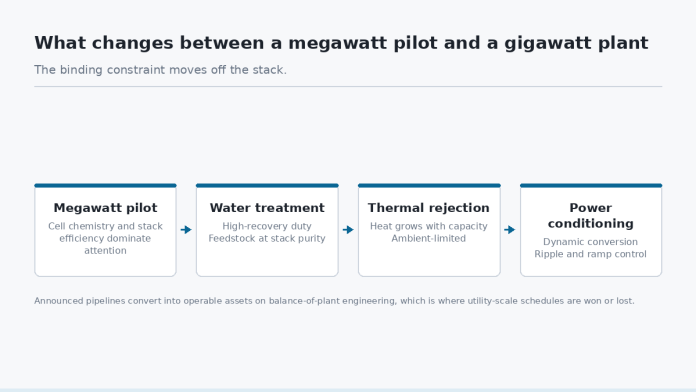
Headline project announcements in 2025—ranging from multi-hundred-tonne-per-day production facilities in the Middle East to continent-spanning hydrogen transport backbones across Europe—signal that the green hydrogen sector has officially moved beyond feasibility studies into site preparation and procurement. However, converting these multi-gigawatt pipeline commitments into operable industrial assets requires engineering teams to move past high-level market assumptions. While early pilot projects focused heavily on cell chemistry performance, commercial success at utility scale is governed by the rigorous balance-of-plant (BoP) engineering: dynamic power conversion, thermal management, and ultra-pure feedstock preparation.
Electrolyzer Stack Dynamics: Current Density, Efficiency, and Thermal Loads
At the core of any green hydrogen facility is the electrolyzer system, where selection between Proton Exchange Membrane (PEM) and Alkaline Electrolysis (AEL) determines the secondary system architecture. AEL operating at current densities of 0.2 to 0.6 A/cm2 utilizes an aqueous potassium hydroxide (KOH, ~25–30 wt%) electrolyte operating at 70°C to 90°C. While AEL benefits from lower capital costs and non-precious catalysts (nickel-based electrocatalysts), its slow dynamic response limits rapid tracking of high-variability wind and solar profiles.
Conversely, PEM systems operate at significantly higher current densities (1.5 to 3.0 A/cm2) and elevated operating differential pressures (up to 30 to 50 bar). This higher current density compacts the stack footprint by a factor of four, but drastically elevates localized heat generation. The theoretical minimum electrical energy required to split water at standard temperature and pressure is 39.4 kWh/kg H2 (based on the higher heating value, or thermoneutral voltage of 1.48 V). Commercial stack-level energy consumption typically sits between 44 and 50 kWh/kg H2. However, when taking into account transformer rectifier losses, gas compression, and auxiliary fluid handling, system-level consumption rises to 52–62 kWh/kg H2.
This efficiency shortfall translates directly into thermal dissipation requirements. For a 100 MW PEM facility operating at an efficiency of 60% (LHV basis), approximately 40 MW of low-grade waste heat (60°C to 70°C) must be dissipated continuously. Managing this heat duty requires dedicated cooling circuits with low parasitic pump power to avoid further compromising plant-level efficiency.
Feedstock Purity and the Unforgiving Water Treatment Bottleneck
A frequent blind spot in facility engineering is the distinction between theoretical stoichiometric water consumption and actual raw water throughput. Stoichiometrically, splitting water requires exactly 8.93 kg of pure H2O per 1 kg of H2 produced. In real-world operation, however, plant water treatment systems must supply between 18 and 26 kg of raw water per kilogram of hydrogen.
This discrepancy stems from necessary balance-of-plant process losses: Reverse Osmosis (RO) reject streams (which purge concentrated total dissolved solids), cooling tower evaporation, system deaeration purges, and continuous flush cycles for electrode reconditioning. In arid or coastal environments—where green hydrogen projects are frequently cited due to rich solar irradiance—raw water sourcing demands aggressive desalination architectures.
“Designing a gigawatt-scale hydrogen facility without a high-recovery, ultra-pure water treatment plant is simply planning for premature electrolyzer stack degradation.”
The purity requirements for cell feedstock are non-negotiable. PEM electrolyzers require ASTM D5127 Type I ultra-pure water with an electrical conductivity under 0.056 µS/cm (resistivity > 18.2 MΩ·cm) and Total Organic Carbon (TOC) levels below 5 ppb. Trace cationic contaminants such as Fe2+, Cu2+, Ca2+, or Mg2+ compete with protons at the active catalytic sites of the membrane, leading to irreversible loss of electrochemically active surface area and membrane fouling. A contamination level as low as 1 ppm of iron in the feedstock water can accelerate stack degradation rates from a standard 1.5 µV/cell/hour to over 10 µV/cell/hour, drastically shortening the stack operational lifetime from 80,000 hours down to fewer than 20,000 hours.
The Multi-Stage Purification Train
To consistently hit Type I standards from raw seawater or brackish groundwater, engineers must design robust multi-stage water treatment trains:
• Primary Treatment: Ultrafiltration (UF) modules to remove suspended solids, turbidity, and colloidal matter.
• Desalination: Two-pass Reverse Osmosis (RO) with energy recovery devices to lower total dissolved solids (TDS) from ~35,000 mg/L down to < 10 mg/L.
• Polishing: Continuous Electrodeionization (CEDI) coupled with mixed-bed polishing resin units to strip residual silica, boron, and trace ionic species down to sub-ppb thresholds.
Dynamic Power Conditioning and Real-World Economics
Coupling electrolyzers directly to off-grid solar and wind assets presents severe power conditioning challenges. Renewable power intermittency induces rapid current cycling, which accelerates mechanical stress on catalyst layers through micro-scale thermal expansion and contraction. Furthermore, power electronics selection profoundly impacts electrochemical stack degradation.
Standard Line-Commutated Rectifiers (LCR) produce significant total harmonic distortion (THD) and low-frequency current ripple. Current ripple induces additional overpotentials at the anode and cathode, accelerating platinum dissolution in PEM cells and nickel degradation in alkaline cells. High-efficiency Insulated Gate Bipolar Transistor (IGBT) active front-end rectifiers reduce current ripple to under 2%, preserving cell lifespan at the expense of higher initial electrical CAPEX.
Levelized Cost of Hydrogen (LCOH) Reality
While industry headlines target an LCOH below USD 2.00 per kg H2 by 2030, current engineering realities dictate a range between USD 3.80 and USD 5.20 per kg H2 at 2025 technology cost baselines. Key cost breakdown factors include:
• CAPEX Impact: Full-system installed CAPEX (including water treatment, power conditioning, stack assemblies, and gas deox/drying units) sits at USD 1,100–1,600 per kW for PEM and USD 700–1,100 per kW for AEL.
• Power Input: Electricity accounts for 65% to 75% of total production cost. Achieving an LCOH of USD 2.00/kg demands power costs below USD 18/MWh at an overall plant load factor exceeding 70%—conditions achievable only in optimal hybrid renewable locations.
Practical Execution Strategy for Engineers
For system integrators and project designers translating commercial ambitions into operational infrastructure, key focus areas must include:
1. Sizing Water Treatment with 30% Margin: Account for fluctuating feed water quality and continuous system blowdown to guarantee uninterrupted electrolyzer operation.
2. Integrated Thermal Recovery: Capture low-grade heat (60°C) from stack cooling loops to drive thermal desalination stages or regional district heating, raising overall plant energy efficiency above 75%.
3. Optimized Power Filtering: Specify multi-pulse or IGBT rectifiers to maintain low harmonic ripple (< 2%) and protect stack membrane integrity under dynamic renewable load profiles.