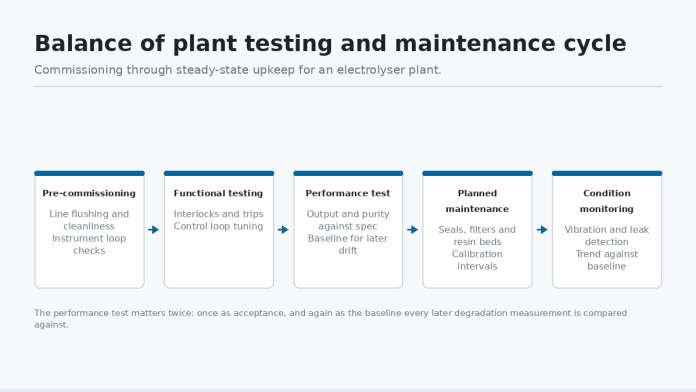

Recent reports highlighting regulatory enforcement, elastomer integrity testing, and cyclic pressure validation under API Standard 53 for offshore subsea Blowout Preventers (BOP) serve as a stark reminder to energy engineers everywhere: high-pressure safety containment systems are only as resilient as their underlying mechanical and maintenance engineering. While subsea oil and gas applications manage well control under extreme pressure, the rapidly scaling green hydrogen sector faces a parallel engineering challenge. In hydrogen generation, “BOP” refers to the Balance of Plant—the complex network of pressure control manifolds, gas-liquid separators, thermal management loops, and ultrapure water treatment trains surrounding the electrolyzer cell stack. Whether handling wellhead hydrocarbon surges at 10,000 psi or managing differential gas pressures across a thin proton exchange membrane at 35 bar, the physical laws governing fluid containment, valve seat integrity, dynamic sealing, and automated shutdown logic remain identical.
The Physics of High-Pressure Containment in Electrolyzer Balance of Plant
Modern megawatt-scale electrolyzer systems operate under severe dynamic mechanical and electrochemical stresses. Proton Exchange Membrane (PEM) electrolyzers typically operate at differential pressures up to 30 to 50 bar to deliver hydrogen directly to downstream compression or storage manifolds without early-stage external mechanical boosters. Meanwhile, advanced pressurized Alkaline Electrolysis (AEL) units operate at elevated system pressures between 10 and 30 bar to reduce downstream volumetric flow rates and dynamic pipe sizing.
At current operating densities ranging from 1.8 to 2.5 A/cm2 for PEM systems and 0.5 to 0.8 A/cm2 for pressurized alkaline units, precise differential pressure management across the cell membrane is critical. A pressure imbalance exceeding ±300 mbar across a polymer electrolyte membrane can cause irreversible structural deformation, cross-over contamination, or catastrophic membrane rupture. Consequently, the mechanical Balance of Plant must employ redundant, rapid-response pilot-operated pressure safety valves (PSVs), back-pressure regulators (BPRs), and automated emergency depressurization manifolds capable of responding within milliseconds.
Furthermore, hydrogen gas presents extreme material compatibility challenges. Under elevated temperatures (60°C to 80°C) and high pressure, atomic hydrogen diffuses into metal lattices, leading to hydrogen embrittlement in lower-grade steels. All process piping, valve bodies, and fitting interfaces in the hydrogen stream must utilize specialized alloys, such as 316L stainless steel with low nickel equivalent variance, or nickel-chromium superalloys like Hastelloy C-276 for highly corrosive oxygen-saturated wet gas lines. Elastomer selection for dynamic valve seals and flanged gaskets is equally stringent; fluoroelastomers (FKM) and ethylene propylene diene monomer (EPDM) compounds must be specifically qualified for explosive decompression (AED) resistance and low-temperature flexibility.
Feedwater Purity and Industrial Water Treatment Architecture
While gas pressure control dictates operational safety, water purification dictates stack lifespan and electrochemical efficiency. Stoichiometrically, the splitting of water requires 8.93 kg of pure H2O per 1 kg of H2 produced. However, when accounting for continuous blowdown, reverse osmosis reject streams, and cooling tower evaporation, real-world facilities consume between 18 and 25 liters of raw water per kilogram of green hydrogen produced.
The core electrolyzer stack demands Ultrapure Water (UPW) matching ASTM Type I or ISO 3696 Grade 1 standards. The required feedwater specifications are non-negotiable:
- Electrical conductivity: < 0.055 µS/cm at 25 °C (Resistivity > 18.2 MΩ·cm)
- Total Organic Carbon (TOC): < 10 ppb
- Silica (reactive): < 3 ppb
- Dissolved transition metals (Fe, Cu, Ni, Cr): < 1 ppb each
Allowing trace metallic cations such as Ca2+, Mg2+, or Fe3+ into the electrolyzer feed stream results in immediate catalyst poisoning. Cations migrate toward the cathode side under the applied electric field, competing with protons for active reduction sites and depositing as insoluble hydroxides. This scales the membrane, increases ohmic resistance, drives up cell operating voltage by more than 5 µV/hour, and generates localized thermal hot spots that degrade noble metal catalyst layers (Platinum and Iridium Oxide).
“While electrolyzer cell stack degradation commands academic attention, operational reality dictates that over 60% of unscheduled green hydrogen plant outages originate within mechanical Balance-of-Plant components and ultrapure water loops.”
To deliver water at this ultra-high purity consistently from variable surface or municipal water sources, Avoltium designs a multi-stage water treatment train: initial multimedia filtration and ultrafiltration (UF), followed by double-pass Reverse Osmosis (RO), continuous Electrodeionization (CEDI), catalytic UV de-ozonation, and final polisher mixed-bed ion exchange resin beds. Maintaining strict continuous monitoring of feed-stream temperature, redox potential, and TOC is essential to prevent biofouling on RO membranes and upstream resin exhaustion.
Energy Penalties, System Efficiencies, and OPEX Dynamics
Evaluating an electrolyzer plant solely on stack DC power consumption yields an incomplete economic picture. A state-of-the-art PEM electrolyzer stack operates at an efficiency of approximately 44 to 48 kWh/kg H2 (Lower Heating Value basis). However, when integrating the entire Balance of Plant—including high-pressure UPW circulation pumps, gas-liquid separator cooling chillers, thermal swing adsorption (TSA) deoxoiser/dryer units, and transformer-rectifier AC/DC power conversion—the total system specific energy consumption rises to 52 to 58 kWh/kg H2.
Balance-of-Plant Power Distribution (Typical 10 MW PEM Facility)
In terms of capital expenditure (CAPEX), the electrolyzer stack accounts for roughly 45% to 55% of total plant cost (1,300/kW installed), while the Balance of Plant and water treatment infrastructure account for the remaining 45% to 55%. Skimping on BOP component quality to lower upfront CAPEX invariably drives up operational expenditure (OPEX) through premature stack degradation, component failure, and parasitic energy losses.
Best Practices for Plant Engineers and Operators
To maximize facility availability (> 96%) and extend stack service life beyond 80,000 operating hours, commissioning and maintenance engineers must embed rigorous operational protocols:
1. Automated Dynamic Leak Detection: Continuous online thermal conductivity gas analyzers (CGAs) and optical flame detectors must be integrated into the plant safety instrumented system (SIS). Alarm thresholds must trigger automated nitrogen purging routines well before cross-over gas concentrations reach 1.5% H2 in O2 (well below the 4% lower explosive limit).
2. Predictive UPW Resin Monitoring: Relying on inline conductivity sensors alone can be misleading, as resin breakdown products may not cause an immediate conductivity spike. Incorporate online TOC analyzers and continuous differential pressure tracking across polishing filter cartridges to detect micro-fouling early.
3. Cyclic Valve Verification: High-cycle dynamic control valves (such as those on TSA desiccant dryer beds) undergo tens of thousands of actuation cycles annually. Implement condition-based monitoring, tracking valve actuation time, seat leakage, and pneumatic actuator pressure drop during routine operational windows rather than waiting for annual turnaround inspections.
By applying the same uncompromising engineering rigor to hydrogen Balance of Plant and water treatment systems that the offshore industry applies to critical well-control hardware, practitioners can build resilient, highly efficient green hydrogen production plants ready for continuous commercial service.