
India’s Hydrail Revolution: Decarbonizing HighSpeed Rail Networks via Advanced Fuel Cell Systems and Green Hydrogen Infrastructure
Engineering Insight: As part of its aggressive target to achieve NetZero Carbon Emissions by 2030, Indian Railways—the world’s fourthlargest rail network—is advancing it…
As part of its aggressive target to achieve NetZero Carbon Emissions by 2030, Indian Railways—the world’s fourthlargest rail network—is advancing its transition toward hydrogen-powered rolling stock (“Hydrail”). Driven by the directives of the National Green Hydrogen Mission and backed by strategic industrial policy, India is positioning fuel cell traction technology not merely as a replacement for dieselelectric multiple units (DEMUs) on nonelectrified routes, but as a core pillar of its next-generation regional and highspeed rail (HSR) infrastructure strategy. Recent market analyses, including comprehensive reporting from Spherical Insights, highlight a surging Indian highspeed train market, propelled by heavy capital expenditure, localized manufacturing under the “Make in India” initiative, and significant technological breakthroughs in heavyduty zeroemission powertrains.
Replacing diesel traction with hydrogen fuel cell technology poses complex electromechanical engineering challenges. Unlike catenarypowered electric multiple units (EMUs) that draw power continuously from an overhead line system (OHE), hydrogen trains operate as mobile, selfcontained power stations. Integrating heavyduty Proton Exchange Membrane Fuel Cells (PEMFC), advanced energy storage buffers, high-pressure onboard storage, and highefficiency traction drives into a tight loading gauge demands sophisticated Balance of Plant (BOP) engineering, optimized thermal management systems, and stringent safety architectures.
Technical Breakdown
The core of modern hydrogen rail powertrains lies in the hybridization of Proton Exchange Membrane Fuel Cells (PEMFC) with highrate lithiumion energy storage systems (ESS). PEMFC technology is uniquely suited for rail applications due to its high power density, relatively low operating temperature (typically between 60°C and 80°C), rapid coldstart capabilities, and fast dynamic response to fluctuating load demands during train acceleration curves.
1. Powertrain Architecture and Fuel Cell Dynamics
In a typical hydrogenelectric multiple unit (HEMU) architecture, the secondary power source—the fuel cell stack—converts chemical energy directly into electrical energy via electrochemical oxidation of hydrogen gas at the anode and reduction of atmospheric oxygen at the cathode:
- Anode Reaction: 2H₂ → 4H⁺ + 4e⁻
- Cathode Reaction: O₂ + 4H⁺ + 4e⁻ → 2H₂O
- Overall Reaction: 2H₂ + O₂ → 2H₂O + Electrical Energy + Waste Heat
To maximize efficiency, the fuel cell operates alongside a primary power buffer, typically a LithiumTitanate Oxide (LTO) or HighPower Nickel Manganese Cobalt (NMC) battery bank, complemented by highcapacity supercapacitors. This hybridization decouples the dynamic response requirements of the train’s traction motors from the fuel cell stack. During rapid acceleration, when power demand spikes dramatically, the battery system delivers immediate peak current. During steadystate cruising, the PEMFC operates at its sweet spot of maximum efficiency (~5560% stack electrical efficiency), supplying power to both the traction DC bus and tricklecharging the battery bank. Crucially, during deceleration, the traction motors act as generators, feeding kinetic energy back into the ESS via dynamic regenerative braking—a key capability impossible in traditional diesel locomotives.
2. Balance of Plant (BOP) and Thermal Management Engineering
The primary engineering bottleneck in heavyduty rail fuel cell integration is not the stack itself, but the Balance of Plant (BOP) and thermal control. Hydrogen fuel cells reject waste heat primarily through the liquid cooling circuit, rather than through exhaust gas, as internal combustion engines (ICE) do. Because the operating temperature of a PEMFC is capped at ~80°C, the temperature differential (ΔT) between the coolant and the ambient environment (which in Indian summer conditions can exceed 45°C) is extremely narrow.
- Heat Exchanger Radiator Sizing: Due to the small ΔT, fuel cell thermal management systems require up to 100150% larger heat exchanger radiator surface areas compared to equivalent diesel engines. Achieving this within the restrictive European/Indian rail clearance diagrams (loading gauge) mandates the use of variablespeed, ultraquiet brushless DC fans and advanced dualcircuit microchannel heat exchangers mounted on the roof line.
- Air Management Systems: Fuel cells require massive volumetric air flows at precise pressures and humidity levels. The air subsystem incorporates variablespeed centrifugal turbocompressors integrated with expanders (to recover exhaust air pressure energy), membrane humidifiers to prevent MEA (Membrane Electrode Assembly) dehydration, and multistage particulate and chemical air filters designed to eliminate sulfur dioxide (SO2), nitrogen oxides (NO_x), and fine ambient particulate matter (PM_{2.5}) that cause severe platinum catalyst poisoning.
- Anode Recirculation & Purge Systems: Hydrogen is supplied to the stack with controlled stoichiometry. Unreacted hydrogen is recirculated using an active hydrogen blower or passive ejector loop to maximize fuel utilization. Water droplets entrained in the recirculation loop are removed via highefficiency cyclonic water separators, with automated purge valves intermittently releasing accumulated nitrogen and moisture.
3. High-Pressure Hydrogen Storage and Refueling Infrastructure
Energy density per unit volume is the single largest spatial constraint for hydrail vehicles. Compressed gaseous hydrogen (cgH2) stored at 350 bar (35 MPa) or 700 bar (70 MPa) is the industry standard for rolling stock applications. Onboard storage utilizes Type IV composite pressure vessels—featuring an seamless highdensity polyethylene (HDPE) or polyamide inner liner fully wrapped in a carbonfiberreinforced polymer (CFRP) epoxy matrix.
Type IV cylinders provide an optimized weighttocapacity ratio, crucial for avoiding axleoverload conditions on 20.3tonne to 22.5tonne axle load lines. Storage banks are mounted in protected rooftop modules, incorporating automated high-pressure solenoid valves, Thermal Pressure Relief Devices (TPRDs) that vent safely upward in extreme thermal events, and localized ultrasonic hydrogen leak detection sensors connected directly to the train control and management system (TCMS).
“Refueling infrastructure requires highthroughput hydrogen dispensing facilities equipped with multistage ionic liquid …”
Refueling infrastructure requires highthroughput hydrogen dispensing facilities equipped with multistage ionic liquid or diaphragm compressors, high-pressure buffer cascades, and integrated precooling units (-40°C) compliant with SAE J2601/SAE J2600 fueling protocols. This enables fastfilling of 100+ kg H2 capacity within a 15to20minute operational dwell window without exceeding the structural temperature limit (85°C) of the vehicle’s Type IV composite storage tanks.
Market & Economic Impact
The economic Viability of India’s hydrogen train initiatives and highspeed rail expansions relies on shifting capital expenditures (CAPEX) into longterm operational savings (OPEX) while achieving absolute decarbonization of nonelectrified routes. While electrification via overhead 25 kV AC catenary systems remains the primary strategy for highdensity arterial routes in India, electrifying remote, lowdensity, mountainous, or heritage corridors (such as the KalkaSimla, Nilgiri, or Jind–Sonipat pilot line) is economically unfeasible due to exorbitant infrastructure installation costs (1.2M to 2M per track kilometer).
Here, Hydrogen Fuel Cell trains present a highly viable, catenaryfree alternative that eliminates huge upfront civil engineering expenditure for overhead lines, substations, and trackside power distribution networks.
Levelized Cost of Hydrogen (LCOH) and Parity Mechanics
The economic viability of hydrogen rolling stock depends directly on the Levelized Cost of Hydrogen (LCOH) delivered at the pump. Currently, green hydrogen produced via water electrolysis in India ranges between 4.50 and 6.00 per kilogram. For hydrail to achieve operating parity with highspeed diesel (HSD) traction and gridfed catenary electric power, the landed green hydrogen cost must decline to approximately 1.50 to 2.00 per kg.
India’s National Green Hydrogen Mission, backed by $2.4 billion in state incentives, directly targets this threshold by driving down production costs through localized electrolyzer manufacturing subsidies (SIGHT scheme) and direct access to lowcost, firm renewable energy (RE). The integration of three main electrolyzer technologies plays a central role in this landscape:
- Proton Exchange Membrane (PEM) Electrolyzers: Offering rapid dynamic response, ideal for coupling directly with intermittent solar and wind generation, though reliant on expensive noble metals (Iridium/Platinum).
- Alkaline Water Electrolyzers (AWE): Mature, low CAPEX technology that forms the baseline for large-scale centralized production hubs, despite lower current densities and slower dynamic ramp rates.
- Solid Oxide Electrolysis Cells (SOEC): Highefficiency (~8085%) hightemperature units that can leverage industrial waste heat from highspeed rail manufacturing corridors and steel mills, drastically reducing electrical power consumption per kg of H2.
Market Dynamics and Supply Chain Maturation
According to research data synthesized in market reports by Spherical Insights, the Indian highspeed rail and zeroemission locomotive market is projected to expand at a compound annual growth rate (CAGR) exceeding 12% over the coming decade. Key industrial OEMs, including Medha Servo Drives, Bharat Heavy Electricals Limited (BHEL), and Indian Railways’ Integral Coach Factory (ICF), are spearheading domestic manufacturing programs. The localized assembly of traction converters, Silicon Carbide (SiC) power electronics, fuel cell power modules, and specialized Type IV storage vessels creates a selfsustaining domestic supply chain that reduces import dependencies on foreign component suppliers.
Future Outlook
The rollout of India’s inaugural hydrogen train on the Jind–Sonipat section (an 89kilometer pilot run featuring a custom 1,200 HP hydrogenelectric hybrid engine built by Medha Servo Drives) marks an essential operational stepping stone. The strategic evolutionary roadmap foresees several clear development vectors extending through 2030 and beyond:
- Scaling Traction Output: Transitioning from current 1.2 MW (1,600 HP) hybrid powerpacks to highcapacity multimegawatt systems capable of powering standard 16coach Vande Bharat express variants and heavy haul freight locomotives capable of speeds up to 160200 km/h.
- Direct HighSpeed Integration: Integrating hydrogenfuelcell auxiliary power units (APUs) into dedicated highspeed rail (HSR) networks, such as the MumbaiAhmedabad bullet train corridor, to supply emergency propulsion, dynamic load shaving, and resilient station microgrid power during maingrid blackouts.
- Standardization and Regulatory Frameworks: Establishing rigorous domestic codes and safety protocols aligned with international rail standards (such as EN 45545 for fire safety, IEC 62864 for hybrid powertrain integration, and ISO 19880 for hydrogen fueling infrastructure).
- Onsite Electrolysis Corridors: Developing trackside green hydrogen refueling hubs powered directly by colocated dedicated solar and wind farms, drastically reducing distribution and cryogenic transport losses via localized “generateanddispense” microgrid nodes.
India’s convergence of highspeed rail infrastructure development with cuttingedge fuel cell technology offers a clean, scalable roadmap for emerging market mobility decarbonization. By overcoming the technical boundaries of Balance of Plant engineering, thermal efficiency management, and localized fuel cell stack manufacturing, India is laying the foundation for a resilient, sustainable, and economically robust zeroemission rail ecosystem.
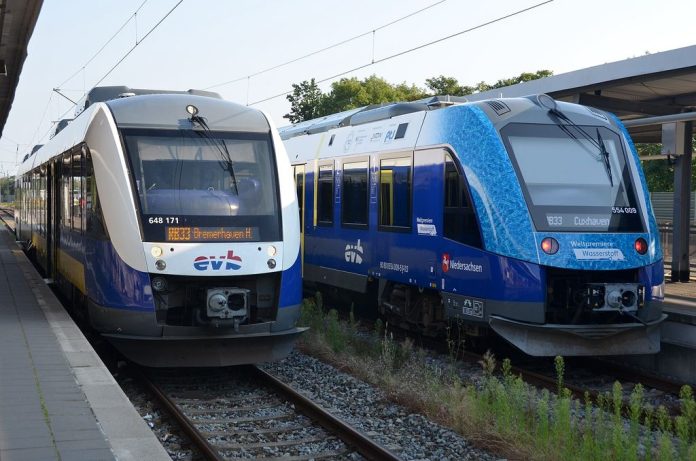
Image: Alstom Coradia Wasserstoff- und Dieseltriebwagen der EVB in Bremerhaven by Olga Ernst, licensed under CC BY-SA 4.0.