
The Thermodynamics and Electrocatalytic Mechanics of Production
At its fundamental level, green hydrogen production involves the endothermic splitting of water into hydrogen and oxygen gases using zero-carbon electricity: 2H2O + electrical energy → 2H2 + O2. From a thermodynamic perspective, the theoretical minimum energy required for this reaction under standard conditions (25 °C, 1 atm) is defined by the enthalpy of formation, resulting in a Lower Heating Value (LHV) requirement of 33.3 kWh/kg H2 (or 237.2 kJ/mol Gibbs free energy input plus entropic heat).
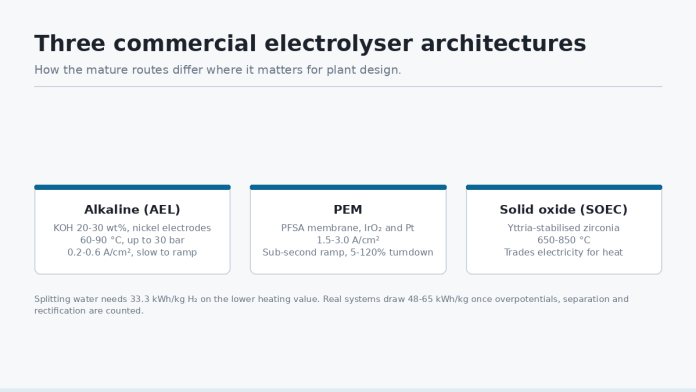
In actual commercial systems, activation overpotentials, ohmic losses across membranes, gas separation parasitic loads, and AC-to-DC rectification losses elevate total system consumption to between 48 and 65 kWh/kg H2. As engineers, we categorize the commercially viable electrolyzer technologies into three primary architectures:
1. Alkaline Water Electrolysis (AEL)
Utilizing a liquid potassium hydroxide (KOH, typically 20–30 wt%) electrolyte and nickel-based catalyst electrodes, AEL is the most mature technology. Operating temperatures range from 60 °C to 90 °C at pressures up to 30 bar. While benefiting from low capital expenditure (CapEx) and non-precious catalysts, AEL operates at relatively low current densities (0.2–0.6 A/cm2) and exhibits limited dynamic response times, making coupling with highly volatile renewable power sources challenging without power smoothing.
2. Proton Exchange Membrane (PEM) Electrolysis
PEM systems utilize a solid perfluorosulfonic acid (PFSA) polymer electrolyte with noble metal catalysts—iridium oxide at the oxygen-evolving anode and platinum at the hydrogen-evolving cathode. Operating at current densities between 1.5 and 3.0 A/cm2, PEM electrolyzer stacks offer rapid ramp rates (sub-second response times) and excellent turndown ratios (5% to 120% of rated capacity). This dynamic capability allows direct integration with variable wind and solar profiles. However, higher catalyst costs and sensitivity to feed contaminants represent major trade-offs.
3. Solid Oxide Electrolysis Cells (SOEC)
Operating at elevated temperatures (650 °C to 850 °C), SOEC utilizes solid ceramic electrolytes (such as yttria-stabilized zirconia). By substituting a portion of the required electrical energy with high-temperature industrial thermal energy, SOEC achieves stack electrical efficiencies approaching 37–45 kWh/kg H2. It is best suited for co-location with heavy industrial processes emitting high-grade waste heat, such as steel plants and nuclear installations.
The Critical Role of Industrial Water Treatment
A frequently overlooked constraint in hydrogen infrastructure is the quality and volume of water required for feedstock. Stoichiometrically, producing 1 kg of H2 requires 8.94 kg of pure H2O. However, in real-world process plants, system blowdowns, reverse osmosis concentrate streams, and cooling tower evaporation push raw water consumption to 18–25 liters per kg of H2.
Electrolyzer stacks are hypersensitive to ionic contamination. Ingesting traces of iron, silica, chlorides, or hardness ions causes rapid poisoning of membrane active sites, catalyst fouling, and loss of stack lifetime. The incoming water treatment process must consistently deliver Ultrapure Water (UPW) matching ASTM Type I standards, with electrical conductivity strictly below 0.1 µS/cm (resistivity > 10 MΩ·cm).
A typical industrial water treatment chain upstream of an electrolyzer includes multi-media filtration, double-pass Reverse Osmosis (RO), Continuous Electrodeionization (CEDI), and a final mixed-bed ion-exchange polishing resin. In arid coastal industrial zones, seawater desalination via energy-recovery reverse osmosis must be integrated into the primary front-end engineering design (FEED).
Industrial Sectoral Integration: Where Hydrogen is Used
Green hydrogen is not an end-use fuel for light duties where direct electrification excels; rather, it is an essential chemical feedstock and reductant for hard-to-abate sectors.
“The economic tipping point for green hydrogen is not determined solely by electrolyzer capital costs, but by securing continuous, high-capacity-factor renewable power at tariffs below $25/MWh.”
Petroleum Refining and Petrochemicals
Refineries are currently the largest consumers of fossil-derived grey hydrogen (produced via Steam Methane Reforming, SMR). Hydrogen is required for hydrotreating (desulfurization) and hydrocracking of heavy crude fractions. Replacing SMR units with green hydrogen supply offers immediate point-source emission reductions without altering downstream refinery assets.
Green Ammonia and Nitrogenous Fertilizers
Ammonia (NH3) synthesis via the Haber-Bosch process requires steady, high-purity hydrogen gas. Transitioning to green hydrogen produces carbon-neutral ammonia, vital for global agricultural supply chains. Furthermore, green ammonia serves as a high-density liquid energy vector, easing long-distance marine transport compared to cryogenic liquid hydrogen (-253 °C).
Direct Reduced Iron (DRI) Steelmaking
Primary steel production via traditional blast furnace-basic oxygen furnace routes relies on metallurgical coal as a reducing agent. In green DRI plants, hydrogen replaces carbon monoxide as the reductant in shaft furnaces, reacting with iron ore (Fe2O3) to yield direct reduced iron and water vapor, cutting steel sector carbon intensities by over 85%.
India’s National Green Hydrogen Mission: Technical Context
India’s National Green Hydrogen Mission targets the creation of at least 5 Million Metric Tonnes Per Annum (MMTPA) of green hydrogen production capacity by 2030. Achieving this target requires an estimated 125 GW of dedicated renewable energy capacity and roughly 60 to 100 GW of global electrolyzer stack manufacturing and installation capacity.
Under the Strategic Interventions for Green Hydrogen Transition (SIGHT) program, policy incentives target two primary domains:
- Component I (Electrolyzer Manufacturing): Financial incentives designed to establish domestic manufacturing bases, evaluated on stack performance metrics, specific energy consumption thresholds (kWh/kg), and local value addition percentages.
- Component II (Production Incentives): Direct performance-linked subsidies per kilogram of green hydrogen produced, structured over a three-year tapering model to bridge the temporary Levelized Cost of Hydrogen (LCOH) gap against grey hydrogen.
To support this, Indian power sector regulations allow Green Energy Open Access, enabling producers to draw renewable power across states with waived inter-state transmission system (ISTS) charges for early-mover projects. The engineering challenge shifts to designing Round-The-Clock (RTC) hybrid renewable power structures—combining solar PV, wind turbines, and energy storage systems—to maximize electrolyzer capacity factors above 65%, minimizing fixed CapEx amortization impact on LCOH.
Practitioner Checklist for Plant Engineering
Engineers and EPC contractors leading project execution must address three non-negotiable plant-level balance requirements:
1. Dynamic Turndown Safety: Ensure alkaline systems do not operate below minimum safe power thresholds (typically 20-25%), which can cause gas crossover and create explosive hydrogen-in-oxygen mixtures (Lower Explosive Limit breaches).
2. Power Conversion Efficiency: Optimize Transformer-Rectifier units. Standard multi-pulse thyristor or IGBT rectifiers must maintain power factors above 0.95 and high harmonic mitigation to prevent grid disturbance.
3. Degradation Budgeting: Factor in 1% to 2% stack efficiency degradation per year (increase in specific kWh/kg consumption) when sizing upstream power plants and water treatment systems over a 20-year operational horizon.