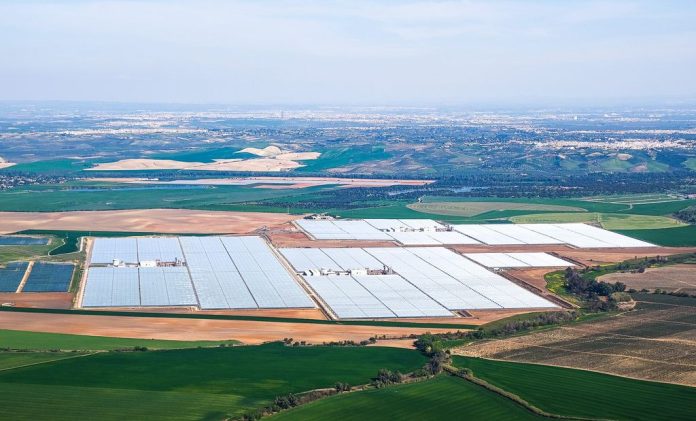

According to Shanghai Metals Market, Sany Hydrogen has won a bid for the additional repurchase of 1000 Nm³/h alkaline electrolyzer equipment destined for the Da’an Wind and Solar Power Green Hydrogen to Synthetic Ammonia Project. While specific financial terms, procurement timelines, and the total stack count for this equipment tranche have not been disclosed, the reliance on standardized 1000 Nm³/h alkaline units reflects current design conventions for megawatt-scale renewable chemical facilities.
Electrolyzer Architecture and Balance-of-Plant Sizing
In industrial hydrogen engineering, a 1000 Nm³/h nominal capacity represents the standard building block for utility-scale alkaline water electrolysis (AWE). Based on the physical density of hydrogen at standard conditions, a 1000 Nm³/h unit produces approximately 89.9 kg of hydrogen per hour. In typical alkaline systems operating with a potassium hydroxide (KOH) electrolyte, driving this output requires a nominal DC input roughly in the 4.5 to 5.0 MW range per stack, depending on specific cell voltage efficiencies and operating current densities.
For plant engineers, the integration of 1000 Nm³/h alkaline trains dictates specific Balance-of-Plant (BoP) duties:
- Water Treatment Duty: Stoichiometric splitting requires 9 kg of pure demineralized water per kilogram of hydrogen produced. Accounting for blowdown cycles, system purges, and demineralization regeneration margins, water treatment units must reliably deliver 10 to 11 kg of high-purity water per kilogram of hydrogen per 1000 Nm³/h train.
- Thermal and Lye Management: Alkaline stacks generate substantial waste heat due to overpotentials. A 1000 Nm³/h train requires dedicated plate heat exchangers and cooling loops to maintain the KOH solution within an optimal thermal window of roughly 60 °C to 80 °C.
- Gas Purification: Raw hydrogen leaving the cathode separator contains entrained moisture and trace oxygen. Meeting catalyst specifications requires downstream deoxygenation reactors and dual-bed temperature swing adsorption (TSA) or pressure swing adsorption (PSA) drying packages to eliminate oxygen and moisture before the gas reaches downstream synthesis loops.
Renewable Interfacing and Downstream Ammonia Coupling
The Da’an project incorporates both wind and solar power generation to synthesize ammonia, introducing significant dynamic operational challenges. Alkaline electrolyzers present inherent operating constraints when coupled directly to variable power profiles. At low load thresholds—typically below 20% to 30% of nominal capacity—gas purity degrades due to the increased relative rate of hydrogen-in-oxygen gas crossover across the porous separator, risking explosive mixtures and triggering automated safety shutdowns.
Furthermore, alkaline systems carry high thermal inertia. Starting an unheated 1000 Nm³/h stack from a cold state can take hours to achieve thermal equilibrium, limiting rapid ramping during sudden renewable swings. In contrast, the downstream Haber-Bosch synthesis loop requires continuous, stable hydrogen and nitrogen feed under high pressures and elevated temperatures. Thermally cycling an ammonia synthesis reactor accelerates catalyst attrition and thermal fatigue in pressure equipment.
Deploying modular 1000 Nm³/h stacks allows facility operators to use multi-unit staging strategies to mitigate this intermittency. Rather than turning down individual units into inefficient or unsafe regimes during periods of low renewable generation, control systems can sequentially cycle individual 1000 Nm³/h units off while maintaining running stacks at optimum current densities. However, because the precise capacity of this procurement and the project’s overall buffer configuration have not been disclosed, plant engineers must rely on intermediate pressurized hydrogen storage or dedicated power-smoothing infrastructure to bridge the operational gap between dynamic electrolysis and steady-state ammonia synthesis.
Source
This analysis was written from reporting by Shanghai Metals Market: Green Hydrogen Project Tracker — Sany Hydrogen Wins Bid for Additional Repurchase of 1000Nm³/h Alkaline Electrolyzer Equipment for Da'an Wind and Solar Power Green Hydrogen to Synthetic Ammonia Project, published 12 October 2026. Figures and events above are as reported there; the engineering commentary is ours.