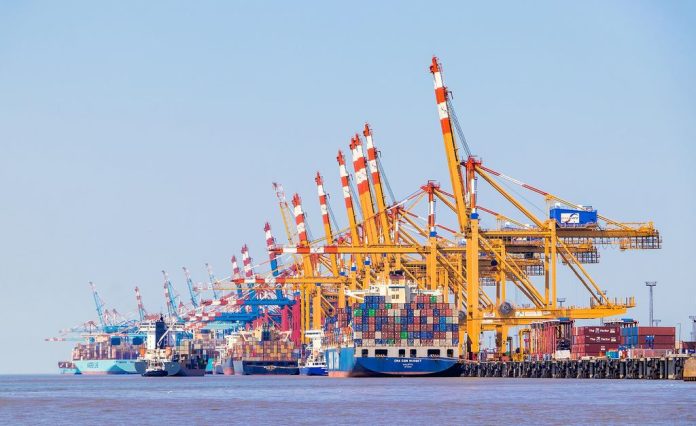

Kandla Port has invited global firms to participate in developing green hydrogen projects, according to Prop News Time. While technical specifications, electrolyser capacities, land allocations, and target commissioning dates have not been disclosed, port-hosted production assets present distinct balance-of-plant parameters that engineering teams and project developers must evaluate during early design phases.
Desalination Duty and Water Treatment Systems
A primary consideration for marine-adjacent hydrogen production is the raw water processing train. Water electrolysis demands high-purity demineralized water to prevent mineral deposition, catalyst poisoning, and premature stack degradation. Stoichiometrically, producing one kilogram of green hydrogen requires approximately nine kilograms of demineralized water. Factoring in cooling tower evaporation, reverse osmosis rejection rates, and system flushes, total raw water requirements typically range between fifteen and thirty kilograms per kilogram of hydrogen.
Because municipal potable water supplies are frequently constrained in industrial port corridors, developers must integrate dedicated seawater reverse osmosis (SWRO) facilities. Engineers must account for marine biofouling, fluctuating silt density index (SDI), and elevated total dissolved solids (TDS) in harbor waters. The resulting permeate must pass through secondary deionization stages, such as continuous electrodeionization (CEDI) or mixed-bed polishers, to reduce electrical conductivity below target thresholds before entering the electrolyser cell stacks.
Power Conditioning and Stack Architecture
Electrolysis stacks require stable low-voltage direct current (DC), requiring substantial electrical balance-of-plant engineering to convert high-voltage alternating current (AC) supplies. Plant electrical engineers must address several critical design factors:
- Rectifier selection: Power conversion units utilizing multipulse thyristor rectifiers or active front-end insulated-gate bipolar transistor (IGBT) topologies must manage reactive power and suppress total harmonic distortion injected back into the interconnecting grid.
- DC ripple mitigation: Excessive current ripple can accelerate degradation of stack catalysts and bipolar plates, necessitating tuned DC smoothing filters to maximize cell longevity.
- Dynamic operating range: Power conditioning systems must support the ramping capabilities of the chosen electrolyser technology—whether alkaline or proton exchange membrane (PEM)—to follow intermittent power inputs effectively.
Offtake Logistics and Port Interface Engineering
Siting hydrogen production directly within port boundaries minimizes terrestrial transport costs and facilitates chemical conversion for marine export or vessel bunkering. Because raw gaseous hydrogen has an exceptionally low volumetric energy density, long-distance maritime export generally relies on converting the gas into carrier molecules, most commonly green ammonia or synthetic methanol.
Consequently, developers must design integrated process boundaries connecting hydrogen production units directly to chemical synthesis loops, cryogenic storage vessels, and insulated transfer pipelines. Process safety engineering requires rigorous hazardous area classification, dynamic vent and flare management, and automated emergency shutdown protocols to prevent combustible gas accumulation within a dense maritime terminal.
From an economic standpoint, the levelized cost of hydrogen remains heavily dictated by delivered electricity pricing and electrolyser utilization factors. Developing projects at a maritime terminal provides clear logistics advantages for marine bunkering and global export, provided the balance-of-plant systems are designed to endure corrosive marine atmospheric conditions.
Source
This analysis was written from reporting by Prop News Time: Kandla Port invites global firms to develop green hydrogen projects, published 11 October 2026. Figures and events above are as reported there; the engineering commentary is ours.