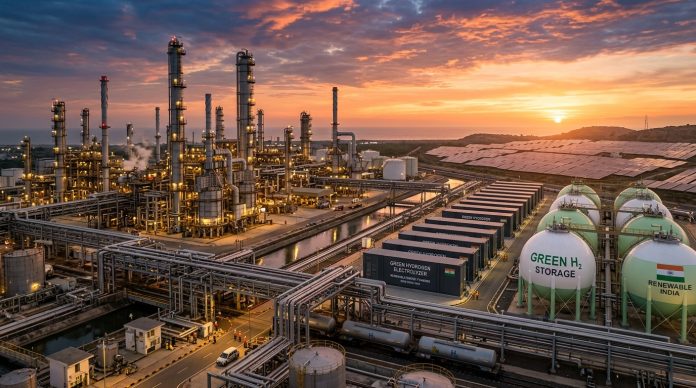

India has awarded contracts for 30,000 tonnes of green hydrogen dedicated to decarbonising state refineries, according to Fuel Cells Works. While specific details regarding individual project allocations, delivery timelines, pricing per kilogram, and targeted refinery locations were not disclosed in the announcement, a supply volume of this magnitude presents clear operational and design considerations for hydrogen plant engineers and project developers.
Electrolyser Sizing and Power Quality Infrastructure
Assuming the awarded 30,000 tonnes represents an annual supply mandate, fulfilling this demand requires substantial power generation and electrolysis capacity. Based on standard low-temperature water electrolysis benchmarks—where modern polymer electrolyte membrane (PEM) or alkaline electrolyser systems consume approximately 50 kWh to 55 kWh of electricity per kilogram of hydrogen produced, including balance-of-plant requirements—a 30,000-tonne annual output demands between 1.5 TWh and 1.65 TWh of continuous electrical energy.
Given the variable capacity factors of solar and wind generation (typically ranging from 25% to 45% without long-duration battery storage), the required installed electrolyser capacity to meet this quota can be estimated between 300 MW and 450 MW of nameplate power. To handle this load, project developers must focus on power conditioning architecture:
- Transformer and Rectifier Units: Multi-pulse thyristor or active front-end (AFE) rectifiers are required to minimize total harmonic distortion (THD) on the high-voltage grid interface.
- Dynamic Load Following: Systems must be specified to ramp rapidly between minimum turn-down ratios (often 10% to 20% for PEM, 20% to 40% for alkaline) and full output without accelerating cell stack degradation.
Water Treatment and Feedstock Logistics
Water feedstock requirements present another critical engineering constraint. Stoichiometrically, splitting water requires 9 kg of pure water for every 1 kg of hydrogen gas generated. For a 30,000-tonne batch, the net chemical water consumption stands at 270,000 cubic metres.
However, when accounting for process losses during reverse osmosis (RO), continuous electrodeionisation (EDI) polishing loops, and cooling tower blowdown, total raw water intake typically ranges from 15 to 25 litres per kilogram of hydrogen produced. Consequently, overall water treatment plant duty will range from 450,000 to 750,000 cubic metres. For refinery sites in arid or inland industrial zones, developers must integrate advanced zero-liquid-discharge (ZLD) systems or sea-water desalination plants upstream to deliver ultra-pure water with electrical conductivity maintained below 0.1 µS/cm.
Refinery Offtake, Compression, and Storage
State refineries utilise hydrogen continuously for hydrodesulfurisation (HDS) and hydrocracking to produce clean transport fuels. Converting these steady, 24/7 processes from steam methane reforming (SMR) gray hydrogen to intermittent green hydrogen introduces strict integration challenges:
- Compression Systems: Electrolysers typically discharge gas at pressures between 10 bar and 30 bar. Boosting this supply to refinery distribution header pressures (often 30 bar to over 100 bar) demands multi-stage oil-free reciprocating or ionic liquid compressors to prevent lube-oil contamination of downstream catalyst beds.
- Buffer Storage: To cushion the discrepancy between intermittent renewable generation and continuous refinery consumption, developers must incorporate high-pressure gaseous storage arrays or linepack management protocols.
Source
This analysis was written from reporting by Fuel Cells Works: India Awards 30,000-Tonne Green Hydrogen Supply Contracts to Decarbonise State Refineries, published 11 August 2026. Figures and events above are as reported there; the engineering commentary is ours.