
Electrocatalytic Kinetics and Strain Engineering
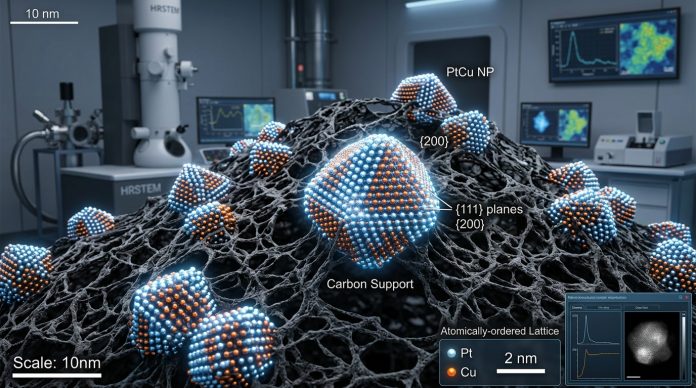
In proton exchange membrane (PEM) fuel cells, the oxygen reduction reaction (ORR) taking place at the cathode is the primary electrochemical bottleneck. The kinetic sluggishness of the ORR requires high loadings of platinum group metals (PGM) to achieve acceptable current densities and energy efficiencies. As reported by Hydrogen Fuel News, researchers at IMDEA Materials have demonstrated that a Cu₃Pt alloy catalyst supported on a nickel-titanium (NiTi) substrate yields ORR performance comparable to conventional pure platinum, despite operating at just 25% of the standard platinum loading.
From a materials engineering perspective, the performance of this system relies on strain engineering. Integrating the Cu₃Pt alloy onto the shape-memory NiTi substrate introduces mechanical lattice strain into the catalytic surface layer. This elastic strain alters the electronic d-band structure of the surface platinum atoms, which directly modulates the binding energy of oxygenated reaction intermediates. By optimizing these intermediate adsorption energies, the catalyst lowers the activation energy barrier for oxygen reduction, driving high catalytic activity despite a drastic reduction in precious metal mass.
Impact on Stack CAPEX and System Integration
For fuel cell stack designers and hydrogen project developers, platinum loading represents a major component of total stack capital expenditure (CAPEX) and a key constraint in supply chain scaling. Achieving equivalent electrochemical performance with a 75% reduction in platinum raw material requirements significantly lowers the bill of materials for membrane electrode assemblies (MEAs). While exact production costs, cell power densities, and volumetric power outputs were not disclosed in the report, reducing precious metal dependency is essential for bringing fuel cell stack costs down to levels competitive with traditional power generation equipment.
Key technical integration considerations for plant engineers evaluating this catalyst development include:
- Capital Cost Reduction: Substantial lowering of PGM material costs per kilowatt of stack output, easing investment barriers for stationary power and high-capacity transport off-take.
- Supply Chain Resilience: Decreased reliance on refined platinum, mitigating raw material price volatility and supply bottlenecks during high-volume manufacturing scaling.
- Load Dynamics: The requirement to evaluate catalytic activity and structural stability under dynamic load cycles and transient thermal conditions typical of real-world hydrogen power operations.
Durability and Scaling Challenges
While lab-scale catalytic activity is promising, translating a strain-engineered alloy catalyst on a NiTi substrate into commercial-scale MEA manufacturing presents distinct chemical and process engineering challenges. PEM fuel cells operate in a harsh, acidic environment at elevated temperatures. Non-precious constituents such as copper (Cu) and nickel (Ni) are susceptible to oxidative dissolution and acid leaching over extended operational lifetimes. If base metal cations leach into the polymeric electrolyte membrane, they can degrade membrane proton conductivity and accelerate chemical ionomer degradation.
Engineering teams must evaluate the long-term chemical stability of the Cu₃Pt/NiTi architecture under extended voltage cycling and start-stop conditions. Furthermore, manufacturing methodologies for applying strain-engineered thin films or nanostructures onto substrates at commercial scale must be developed without compromising lattice strain uniformity. Until multi-thousand-hour durability data and industrial synthesis pathways are demonstrated, project developers should view this advance as an important milestone for catalyst design that requires thorough validation before commercial plant integration.
Source
This analysis was written from reporting by Hydrogen Fuel News: Strain-Engineered Cu₃Pt Catalyst Cuts Platinum by 75% in Hydrogen Fuel Cell Cathodes, published 10 August 2026. Figures and events above are as reported there; the engineering commentary is ours.