
According to ET EnergyWorld — Renewable, GSFC is looking for a joint venture partner to construct a green ammonia manufacturing facility at Sikka, Gujarat. The project is planned for commissioning by December 2030, with offtake targeted at export destinations in Europe, Japan, and South Korea. The upstream infrastructure will require 2 to 3 GW of dedicated renewable energy capacity. While specific electrolyser configurations, daily output ratings, and balance-of-plant sizing have not been disclosed, the stated power requirements and site location establish clear engineering boundary conditions for plant designers.
Power Conditioning and Upstream Plant Integration
A renewable power allocation of 2 to 3 GW indicates an industrial-scale synthesis facility, but coupling variable power to a thermochemical synthesis loop presents distinct technical trade-offs. The specific split between solar photovoltaic and wind capacity has not been disclosed, yet high-capacity-factor generation will be essential to maintain stable plant operation. Conventional Haber-Bosch ammonia synthesis loops operate under elevated pressures and temperatures, typically requiring steady operating conditions to prevent thermal cycling and catalyst fatigue.
To integrate an intermittent 2 to 3 GW generation profile, project engineers must design an electrical balance-of-plant that combines wide-band power conditioning with dynamic operational limits. The project team will need to determine how much of the renewable profile directly powers the electrolysers and what proportion requires intermediate smoothing. If the plant does not rely on extensive battery energy storage systems, the electrolysers must possess high ramp-rate capabilities to track variable generation. Furthermore, the synthesis loop itself will demand either intermediate hydrogen buffer storage—such as compressed gas vessels or geologic storage, if available—or dynamic loop synthesis reactors capable of wide turndown ratios without tripping.
Balance of Plant and Maritime Export Interface
The chosen site at Sikka in Gujarat offers distinct marine access advantages that will govern both water treatment and product logistics. Water electrolysis requires ultrapure demineralised water feedstocks to avoid cell degradation and membrane fouling. Given the coastal location, the facility will depend on seawater reverse osmosis followed by extensive electrodeionisation polishers. Managing the high power demand and continuous brine rejection of a large-scale desalination plant must be coordinated with the main hydrogen generation train.
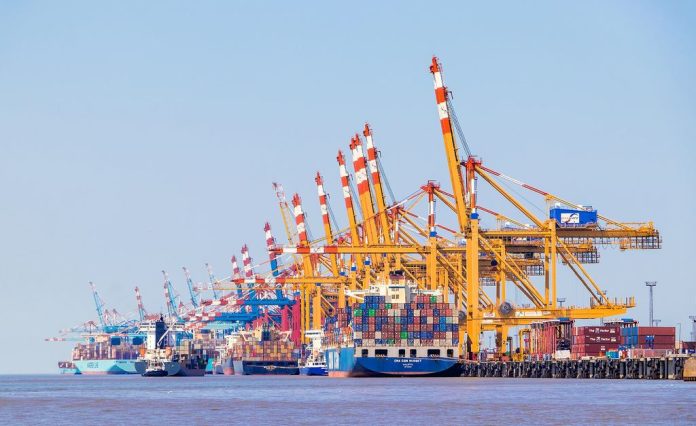
Direct coastal access also addresses the complex logistical challenges of moving bulk ammonia. Transporting ammonia inland is capital-intensive and presents severe pipeline or rail permitting hurdles. At Sikka, locating synthesis units near deepwater terminal infrastructure simplifies the integration of atmospheric refrigerated ammonia storage tanks and cryogenic boil-off gas handling loops. Direct marine loading arms will allow the facility to service large gas carriers dedicated to the intended long-haul maritime routes to Europe and East Asia.
Offtake Compliance and Certification Alignment
Targeting export destinations across Europe, Japan, and South Korea requires the design team to navigate diverging compliance criteria long before commissioning in 2030. For European deliveries, the plant must satisfy the European Union framework for Renewable Fuels of Non-Biological Origin. This imposes rigorous engineering controls regarding additionality, geographic correlation, and temporal correlation between renewable generation and hydrogen production. Meeting hourly or monthly correlation metrics directly dictates whether electrolysers can draw auxiliary power from the regional grid during periods of low local generation.
Conversely, offtakers in Japan and South Korea prioritize clean ammonia primarily for power generation co-firing and industrial heating, with certification regimes focused heavily on total life-cycle carbon intensity thresholds. Engineering teams will need to implement automated energy tracking and mass-flow metering systems capable of auditing carbon intensity across every unit operation, from the renewable busbar down to the export loading flange.
Source
This analysis was written from reporting by ET EnergyWorld — Renewable: GSFC seeks joint venture partner for green ammonia factory in Gujarat, published 10 October 2026. Figures and events above are as reported there; the engineering commentary is ours.