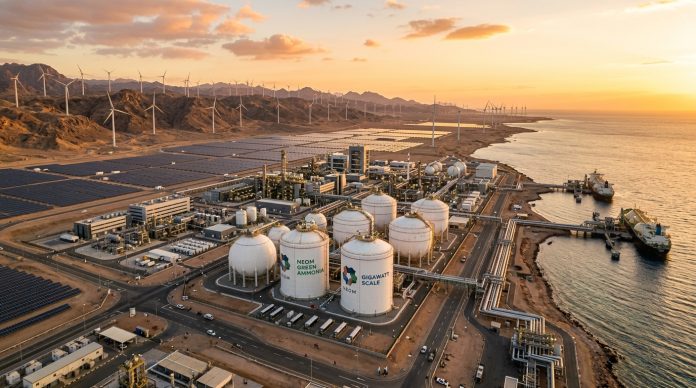

The construction phase has concluded for the world’s largest commercial-scale green hydrogen plant located in Saudi Arabia, according to a report by Green Building Africa. While specific nameplate capacity figures and equipment vendors were not detailed in the release, reaching mechanical and civil completion on a facility of this scale represents a significant engineering milestone. For EPC contractors and plant operators, moving past the construction phase shifts technical risk from structural execution to subsystem loop checking, nitrogen inerting, high-voltage energisation, and stack activation.
Power Conditioning and Grid Integration Challenges
At commercial scale, integrating large electrolyser arrays requires sophisticated balance-of-plant (BoP) electrical infrastructure. The conversion of upstream renewable electricity into low-voltage, high-current direct current (DC) presents critical design and operational considerations:
- Rectifier Topology: Large-scale installations demand either multi-pulse thyristor rectifiers or active front end (AFE) IGBT-based converters to minimise total harmonic distortion (THD) reflected back into the supply network.
- Dynamic Turndown: Intermittent power profiles require the electrical conditioning architecture to handle broad ramping rates while maintaining power factor requirements across individual stack skids.
- Busbar and Cable Losses: Managing high current loads requires short DC bus runs and optimised busbar cooling to prevent substantial resistive losses within the electrolyser halls.
Operating in an arid Middle Eastern climate adds significant ambient thermal strain. High dry-bulb temperatures increase parasitic cooling loads across transformer-rectifier units, demanding robust closed-circuit liquid cooling systems to maintain converter and stack efficiency.
Water Deionisation Duty and Feedstock Pre-Treatment
From a chemical engineering perspective, green hydrogen production imposes strict feedstock purity requirements. While stoichiometric dissociation requires approximately 9 kilograms of pure water per kilogram of hydrogen produced, real-world utility consumption is higher once blowdown, continuous purging, and water treatment rejection rates are considered.
In coastal or arid operational environments, facilities must integrate dedicated seawater desalination units coupled with multi-stage polishing trains, typically featuring double-pass reverse osmosis (RO), continuous electrodeionisation (CEDI), and mixed-bed ion exchange. To protect stack catalyst layers and membrane assemblies from fouling or poisoning, conductivity must consistently remain below 0.1 microsiemens per centimetre (µS/cm). Reaching construction completion implies that these high-spec utility blocks, including ultra-pure water storage and deaeration systems, are fully installed and ready for hydraulic pressure testing and water loop circulation.
Subsystem Commissioning and Offtake Preparedness
With mechanical completion achieved, the plant enters integrated pre-commissioning. This phase involves de-oxygenation, pressure swing adsorption (PSA) validation, hydrogen gas compression, and balance-of-plant leak integrity testing under helium or nitrogen atmospheres prior to introducing live hydrogen gas.
Commercial viability will hinge on offtake integration. For mega-scale installations, continuous hydrogen output requires immediate downstream synthesis, such as conversion into liquid carriers, green ammonia, or integration into dedicated high-pressure storage buffers to smooth out variability between dynamic generation and continuous transport or industrial consumption.
Source
This analysis was written from reporting by Green Building Africa: World’s largest commercial scale green hydrogen plant reaches construction completion in Saudi Arabia, published 14 August 2026. Figures and events above are as reported there; the engineering commentary is ours.